From the influential bloodlines of Ramiro Z and Cottage Son xx to international Grand Prix sport and generations of successful sport horses.
Few stallions demonstrate the versatility of European Warmblood breeding as clearly as Saluut. Born in Germany in 1976, this Holsteiner stallion combined an international show jumping career with a remarkable contribution to the breeding of jumping and dressage horses.
Known internationally as Maximillian Saluut, he descended from some of the most influential bloodlines in European sport horse breeding. His pedigree united the established jumping heritage of Ramiro Z with the Thoroughbred influence of Cottage Son xx, while his own performance and the achievements of his descendants contributed to his international reputation.
His breeding career extended well beyond continental Europe, producing approved stallions, successful competition horses and breeding mares whose influence continued through subsequent generations.
For Maverick Stables, Saluut holds a particularly meaningful place in our breeding history. As the maternal grandsire of our foundation mare Rosa-Lott, his bloodlines form an important connection between our present breeding programme and earlier generations of Dutch and Holsteiner breeding.
Saluut’s pedigree brings together some of the most influential families in Holsteiner breeding. Through Ronald, Ramiro Z and Consul, his ancestry reflects generations in which established European bloodlines were combined with Thoroughbred influence to contribute to the development of the modern sport horse.
Saluut was born on 7 April 1976 in Germany. Bred by H. Kruse, he was a bay Holsteiner stallion by Ronald out of Elma, by Fanfar. He stood approximately 1.72 metres and was registered with the Holsteiner Verband under identification number 210401176.
His pedigree reflects an important period in European horse breeding. During the second half of the twentieth century, breeders increasingly selected horses for their suitability for modern equestrian sport, with particular emphasis on athletic ability, movement, temperament and performance under the rider.
The introduction of Thoroughbred blood played an important role in this development. Within Holsteiner breeding, stallions such as Cottage Son xx contributed to the evolution of the traditional horse into an increasingly specialised sport horse.
Saluut inherited this breeding background through both his paternal and maternal ancestry. His subsequent sporting and breeding career would provide an opportunity to evaluate how these established bloodlines developed in later generations.
Saluut’s sire, Ronald, was born in 1970 and was a son of Ramiro Z out of Adrette, by Heilbutt.
Ronald was approved by the Holsteiner and KWPN studbooks and became an important breeding stallion. His descendants were represented in international jumping and dressage, while his daughters contributed to subsequent generations of European breeding.
One particularly successful horse from Ronald’s maternal influence was Libero H, by Landgraf I out of Oktave, by Ronald. Under Jos Lansink, Libero H developed into one of the leading international jumping stallions of his generation, winning the 1994 World Cup Final in ‘s-Hertogenbosch.
Ronald’s sire, Ramiro Z, was born in 1965 and was a son of Raimond out of Valine, by Cottage Son xx.
Ramiro competed internationally in Grand Prix show jumping under Frits Ligges and subsequently established an exceptional breeding career. His descendants became influential within numerous European Warmblood populations.
Among his most celebrated offspring was Ratina Z, whose international career included Olympic medals, championship victories and some of the most prestigious competitions in show jumping.
Ramiro’s influence extended far beyond his direct offspring. Through approved sons, successful breeding mares and subsequent generations, his bloodlines became established in major international jumping families.
Through Ronald, Saluut inherited a direct connection to this influential sporting and breeding heritage.
While Saluut’s paternal pedigree contains some of the best-known names in international jumping breeding, his maternal ancestry is equally interesting.
His dam, Elma, was a Holsteiner mare born in 1968, by Fanfar out of Austria, by Consul.
Fanfar, born in 1964, was a son of Fasching out of Reverenz. His ancestry represents older Holsteiner breeding lines that contributed to the development of the breed during a period of increasing specialisation towards the modern riding horse.
Through Elma’s dam, Austria, another particularly significant stallion appears in Saluut’s pedigree: Consul.
Consul was a son of the Thoroughbred Cottage Son xx out of Isolde, by Gabriel. His influence extended through several generations of European breeding and included descendants successful in different equestrian disciplines.
Among his best-known offspring was Granat, the outstanding international dressage horse ridden by Christine Stückelberger. Their achievements included major championship victories and Olympic success, establishing Granat as one of the most celebrated dressage horses of his generation.
Consul also appears further back in the ancestry of Corlandus, the internationally successful dressage horse ridden by Margit Otto-Crépin, who won individual silver at the 1988 Olympic Games in Seoul.
These examples illustrate the contribution of Consul’s bloodlines to dressage, providing an interesting contrast to the jumping influence represented by Ramiro Z.
Through Elma, Saluut carried both of these established breeding influences into his own pedigree.
One of the most distinctive characteristics of Saluut’s pedigree is the repeated presence of Cottage Son xx.
Born in Britain in 1944, Cottage Son became an influential Thoroughbred stallion within Holsteiner breeding. His introduction formed part of the wider development of the traditional Holsteiner into a horse increasingly suited to modern riding and equestrian sport.
In Saluut’s pedigree, Cottage Son occurs through two separate branches.
On his paternal side, the connection runs through Ronald, Ramiro Z and Ramiro’s dam, Valine. On his maternal side, Cottage Son appears through Elma, Austria and Consul.
This repetition is an interesting example of how particular bloodlines became established and consolidated within European Warmblood breeding.
For breeders, such patterns are relevant when examining historical breeding decisions, relationships between ancestors and the development of particular families.
However, the presence of an influential ancestor does not by itself establish which characteristics a horse inherited from that individual. Athletic ability, temperament, conformation and movement are influenced by numerous genetic and environmental factors.
Saluut’s own performance and the achievements of his descendants therefore provide the most meaningful information when evaluating how his pedigree developed in practice.
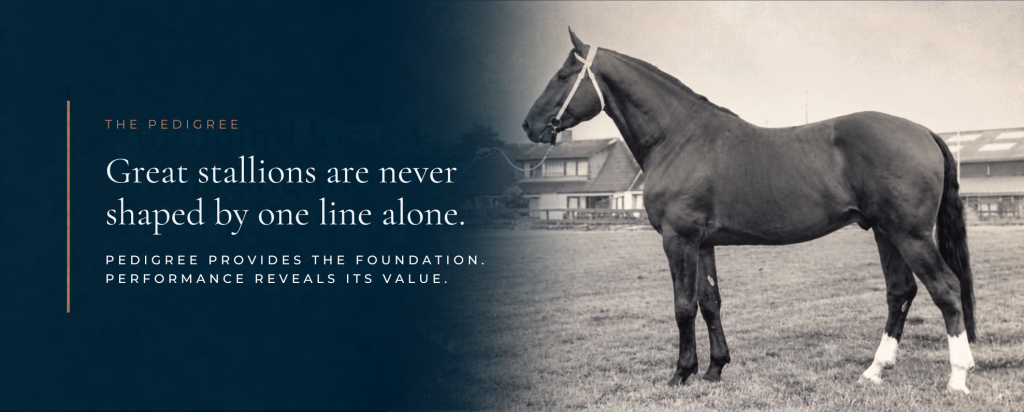
Before establishing his international breeding reputation, Saluut demonstrated his own athletic ability. His Dutch performance-test results and subsequent Grand Prix jumping career provided a strong foundation for his development as a breeding stallion.
Saluut completed a 100-day performance test in the Netherlands, where his athletic ability, riding qualities and temperament were evaluated.
His results were particularly strong in jumping and temperament. He received 9.0 for jumping under the rider, 8.5 for free jumping and 9.0 for temperament.
His riding test and cross-country performance were both awarded 7.5, while his in-harness test received 7.0. His stable and training report was assessed with 9.0, contributing to a total recorded score of 57.5 points.
These results provide a valuable insight into his individual evaluation. His jumping scores demonstrated his sporting aptitude, while the assessments of temperament and training behaviour provided additional information about his suitability as a breeding stallion.
The inclusion of cross-country and in-harness assessments also reflects the broader approach to performance testing that characterised earlier generations of Dutch Warmblood breeding.
Following his performance testing, Saluut received KWPN approval. His international breeding recognition subsequently extended to the United Kingdom, where he achieved the highest grading level with Sport Horse Breeding of Great Britain (SHB(GB)), the British Warm-Blood Society (BWBS) and the Anglo European Studbook (AES).
His combination of performance-test results, breeding approval and subsequent sporting achievements contributed to his international reputation.
Saluut developed into an international Grand Prix show jumper, competing under the name Maximillian Saluut.
His sporting career distinguished him from stallions whose breeding reputation was based primarily on pedigree, conformation or the achievements of their relatives.
By competing at international Grand Prix level, Saluut demonstrated his own ability in the discipline for which much of his Holsteiner ancestry had been developed.
His athletic qualities, movement and sporting experience subsequently contributed to his reputation as a breeding stallion.
Although primarily recognised as a show jumper, historical descriptions published by Maximillian Stud also highlighted his potential for dressage.
This assessment was partly subjective, but the subsequent achievements of his offspring in both jumping and dressage would provide further evidence of the versatility represented within his breeding record.
His sporting career therefore became an important part of his contribution to European Warmblood breeding.
One of the most remarkable historical presentations involving Saluut took place during the 1986 UTV in Utrecht. Organised by Dutch horseman Henk van Tuyl, the show brought together approved breeding stallions, dressage horses, jumpers, eventers and harness horses, offering an impressive demonstration of the versatility of the Dutch Warmblood.
Van Tuyl, from Gameren, was already widely recognised for his achievements with Dutch harness horses. Between 1968 and 1971, he won the national open-class championship with Rumanus. His later stable became associated with prominent horses such as the approved stallion Renovo and the successful harness horse Dietlof.
For the 1986 presentation, Van Tuyl assembled an exceptional programme involving some of the leading equestrian personalities of the period.
Saluut played a central role in the show, accompanied by a collection of his offspring representing different equestrian disciplines.
His descendants performed in a dressage carousel, while a steeplechase featuring jumping and eventing horses demonstrated another aspect of their athletic ability.
One of the most memorable moments was the presentation of four of Saluut’s approved sons: Zeppelin, Actueel, Beethoven and Beltrum.
Ridden by Albert Voorn and Gerd Meier, the stallions appeared together in a coordinated demonstration reminiscent of the traditional stallion parades at Warendorf and Celle.
Another remarkable performance was provided by IJsbrand Chardon, who drove a four-in-hand consisting of four-year-old offspring of Saluut.
The programme also featured Piet Raymakers and Emiel Hendrix, while the harness horses Renovo, Zendgraaf, Alwin and Veritas appeared in an impressive four-in-hand presentation driven by Egbert Emmink.
The event was documented in the Dutch publication In de Strengen, which described the atmosphere of the show and the remarkable collection of horses brought together by Van Tuyl.
For Saluut, the presentation was particularly significant because it demonstrated the achievements of his offspring across several disciplines at the same event.
Rather than highlighting a single exceptional descendant, the programme offered a broader picture of his early breeding influence and the different qualities represented among his offspring.
The historical account provides valuable evidence that Saluut had already established an important breeding reputation in the Netherlands by the mid-1980s.
Historical source: In de Strengen (1986). Archival footage preserved by Het Tuigpaard / The Dutch Harness Horse Collection.
Saluut’s breeding influence extended far beyond his own sporting career. Through approved stallions, international competition horses and influential breeding mares, his bloodlines became established in different countries and across several equestrian disciplines.
Saluut’s breeding career extended beyond Germany and the Netherlands, with an important period in the United Kingdom.
There, he became known as Maximillian Saluut and was associated with Maximillian Stud in Devon.
By the beginning of the twenty-first century, he had developed an international reputation as a sire of successful jumping and dressage horses.
In February 2003, Horse & Hound published a profile based on information supplied by Maximillian Stud. At that time, the stud reported that Saluut had produced more than 312 successful show jumpers, 306 dressage horses, 362 graded mares and 16 graded stallions worldwide.
These historical figures illustrate the scale of his international breeding reputation. They represent the results reported by his stud at that time rather than a complete, independently verified record of every horse descending from Saluut.
The KWPN database separately records 609 offspring within its Dutch breeding administration. Because his descendants were also registered through international studbooks, this figure should not be interpreted as his complete worldwide production.
His breeding influence subsequently continued through descendants registered in different national breeding programmes, including those in the United Kingdom and Australia.
One of the most remarkable achievements associated with Saluut’s breeding career was the selection of two of his offspring for the 1996 Olympic Games in Atlanta, representing two different equestrian disciplines.
Faust represented Canada in dressage under Gina Smith. The combination competed in the Olympic Grand Prix, finishing 46th individually and contributing to Canada’s tenth-place finish in the team competition.
His other offspring, Famous, was reportedly selected to represent New Zealand in show jumping. Although this selection was documented in historical information from Maximillian Stud, his actual participation in the Olympic competition has not been confirmed in the official results.
The presence of Saluut’s descendants in two different Olympic disciplines is particularly interesting when examining his international breeding reputation.
It illustrates the versatility associated with his offspring and the ability represented within his breeding record to produce horses capable of reaching the highest levels of international equestrian sport.
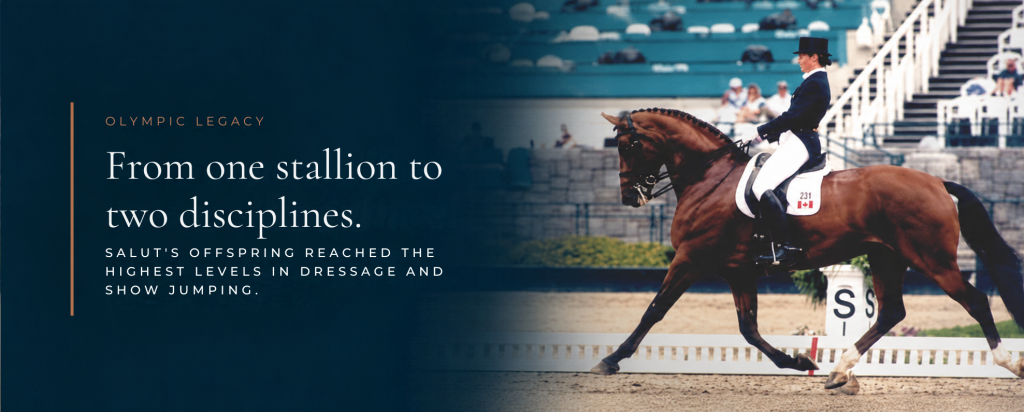
An important part of Saluut’s breeding influence was his ability to produce sons that were themselves selected for breeding.
The KWPN records four approved first-generation sons: Zeppelin, Actueel, Beltrum and Beethoven.
Zeppelin, born in 1981, was bred out of a mare by the Thoroughbred Vesins xx. Actueel, born in 1982, was another son of Saluut out of a Vesins xx mare.
These combinations brought together Saluut’s Holsteiner ancestry with additional Thoroughbred influence.
Beltrum, born in 1983, was bred out of a mare by Amor, combining Saluut’s bloodlines with another established Holsteiner breeding family.
Beltrum subsequently competed at 1.60 m in show jumping, representing an important sporting achievement among Saluut’s approved sons.
Beethoven, also born in 1983, was bred out of a mare by Epigoon and received KWPN approval.
All four stallions were presented together during the 1986 UTV show, providing an impressive demonstration of Saluut’s early contribution to the next generation of approved breeding stallions.
Beyond the Netherlands, his international breeding career produced additional registered and graded stallions, including Maximillian Metropolis and Maximillian Marakesh.
Their registration in the Anglo European Studbook illustrates how Saluut’s influence as a sire of breeding stallions continued beyond his original Dutch career.
One of Saluut’s most significant international breeding branches developed through his son Salute, a bay stallion born in 1986 out of Inia, by Amor.
In 1989, Australian horsewoman Rozzie Ryan discovered Salute in England, and he was imported into Australia shortly afterwards.
His subsequent breeding career became particularly influential within Australian sport horse breeding, producing descendants successful in dressage, show jumping and eventing.
One of his most successful offspring was Victory Salute, who competed at international Grand Prix dressage level under Brett Parbery.
At the 2010 World Equestrian Games in Lexington, the combination finished ninth individually, representing a significant achievement for Australian dressage.
Another notable offspring was Stirling Stilton, who represented Australia at the 2002 World Equestrian Games in Jerez.
Salute also produced DP Christopher, an Australian Grand Prix dressage champion, and Stirling Sprite, who achieved success in advanced eventing and international show jumping.
His contribution to eventing was particularly noteworthy. Among his descendants were Stirling Soux and F1 Pharenelli, both recorded at four-star level, and Sydney Lights, who competed at three-star level.
His influence continued into subsequent generations through Staccato, a son of Salute out of the Thoroughbred mare Smiler.
Staccato developed into an internationally successful eventing stallion and subsequently achieved results in dressage. His descendants contributed further to Australian eventing, including Panamera and Sandhills Brillaire, who won the Adelaide four-star competition in consecutive years.
Through Salute and his descendants, Saluut’s bloodlines became established within Australian sport horse breeding, extending his influence across several disciplines and generations.
Although approved sons and successful competition horses often receive the greatest public attention, the contribution of a stallion’s daughters can be equally significant.
Saluut produced numerous mares that subsequently became part of Dutch and international breeding programmes.
Through these daughters, his bloodlines were combined with different breeding families, allowing subsequent generations to develop according to the objectives of individual breeders.
The quality of their offspring, their breeding predicates and their contribution to later generations provide valuable information when examining the long-term influence of a stallion.
Among the mares associated with Saluut’s international breeding career were Maximillian Mustique, Maximillian Moonshine and Sonata, whose registrations illustrate the continuation of his bloodlines through breeding mares outside the Netherlands.
Within Dutch breeding, his influence through the female line also became particularly meaningful.
For Maverick Stables, one of those daughters would eventually establish an important connection between Saluut’s breeding career and our own family history.
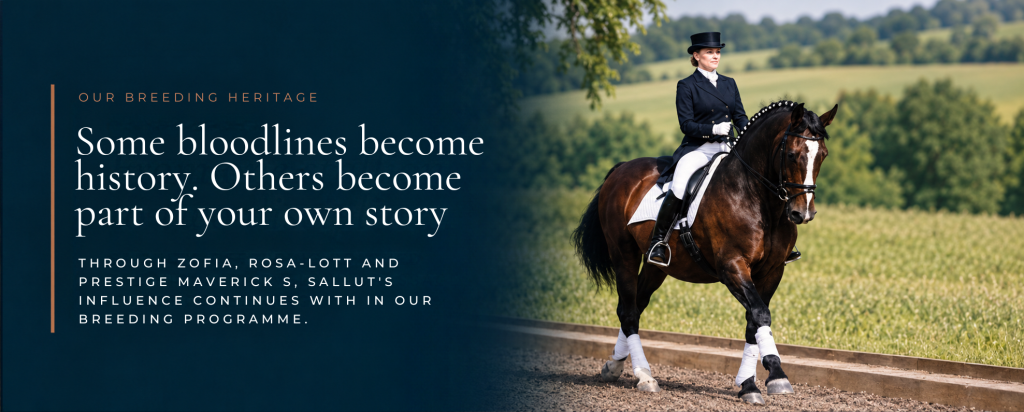
Saluut’s place in our breeding history begins with his daughter Zofia.
Born in 1981, Zofia was bred out of Tironetje, by Duc de Normandie. She received the ster predicate and competed at 1.30 m in show jumping.
Through her maternal ancestry, Zofia belonged to Dutch breeding family 1800, whose history is rooted in the older Gelderland breeding population.
She was subsequently bred to the Thoroughbred stallion Julio Mariner xx, bringing together two distinct breeding backgrounds.
Through Saluut, Zofia carried established Holsteiner bloodlines, including the influence of Ramiro Z and Cottage Son xx. Julio Mariner introduced direct Thoroughbred influence through a different breeding family.
In 1998, this combination produced Rosa-Lott.
Rosa-Lott distinguished herself during her early evaluations, receiving 78 points for conformation and movement and an invitation to the National Mare Inspection.
She subsequently completed the IBOP jumping performance test with 75 points and received the elite, preferent, IBOP-(SPR) and D-OC predicates.
Through her descendants, Rosa-Lott became an important part of our family’s breeding history, long before the introduction of the Maverick name.
Her female line has continued through successive generations. Today, Prestige Maverick S, a daughter of Cohinoor VDL out of Rosa-Lott, represents a direct continuation of this maternal family within our breeding programme.
Through Prestige and her descendants, Saluut remains part of the breeding heritage of Maverick Stables.
Saluut’s breeding history offers a valuable perspective on the development of the modern European sport horse.
His pedigree combined established Holsteiner jumping bloodlines with the repeated influence of Cottage Son xx. His performance-test results and international Grand Prix career demonstrated his individual sporting ability, while his descendants subsequently achieved success in several equestrian disciplines.
The 1986 UTV presentation provides a particularly remarkable historical illustration of this versatility, demonstrating how his offspring were already represented in jumping, dressage, eventing, driving and breeding.
His international breeding career subsequently extended that influence beyond continental Europe, with descendants achieving important results in the United Kingdom, Australia and other countries.
Through approved stallions, successful competition horses and breeding mares, his bloodlines continued into generations shaped by the objectives of different breeders and breeding programmes.
For Maverick Stables, Saluut’s significance is closely connected to the importance we place on understanding the complete pedigree of a breeding mare.
A maternal family is shaped not only by its direct female ancestry, but also by the stallions introduced over successive generations and the qualities they contribute.
Through Zofia, Rosa-Lott and Prestige Maverick S, Saluut forms an important part of the history that connects our family’s earliest breeding activities with the future of Maverick Stables.
His legacy is therefore more than a record of individual sporting achievements or successful offspring. It is a contribution to generations of European sport horse breeding that continues through the families he helped establish.
KWPN Database — Saluut (1976). Official pedigree, registration, performance-test scores, breeding records and approved first-generation sons.
KWPN Database — Ronald. Pedigree and breeding information concerning Saluut’s sire.
Horse & Hound — Focus on Maximillian Saluut (2003). Historical sporting and breeding information supplied by Maximillian Stud.
Maximillian Stud — Saluut. Historical stud information and reports concerning his international offspring.
FEI — Gina Smith. Official Olympic results, including Faust’s participation in the 1996 Atlanta Games.
FEI — Atlanta 1996 Olympic Games. Historical Olympic competition information.
UTV 1986 — Show Elisabeth’s Hof. Historical footage from Het Tuigpaard / The Dutch Harness Horse Collection, accompanied by the original report from In de Strengen (1986).
Ryans Horses — Salute (imp). Australian breeding history and notable descendants of Salute.
Sandhills — Staccato. Sporting and breeding information concerning Saluut’s grandson Staccato.
Anglo European Studbook — Maximillian Metropolis. British stallion registration and pedigree.