Laryngeal hemiplegia, commonly associated with roaring in horses, is a condition frequently discussed during the selection of young breeding stallions. Yet for many breeders, it remains unclear what is actually being examined and why this examination matters.
What causes the characteristic respiratory noise? Is roaring hereditary? Can an affected horse continue to perform normally? And why does the KWPN impose specific requirements on the respiratory function of prospective breeding stallions?
Within stallion selection, considerable attention is given to movement, jumping ability, conformation, pedigree and athletic potential. However, a prospective breeding stallion must also possess a physical foundation appropriate for his potential future as both a sport horse and a sire.
For this reason, the KWPN does not assess radiographic health alone. The respiratory system is also examined, with particular attention paid to laryngeal function.
Understanding recurrent laryngeal neuropathy (RLN), its possible hereditary influence and the limitations of early veterinary screening is therefore an important part of responsible sport horse breeding.
Laryngeal hemiplegia is a disorder affecting the larynx, commonly known as the voice box, in which one side loses some or all of its normal muscular function.
The condition is closely associated with recurrent laryngeal neuropathy (RLN), a disease affecting the nerves responsible for controlling the muscles of the larynx.
In Dutch, the condition is traditionally referred to as cornage. In English, affected horses are often described as roarers, because of the distinctive respiratory noise that can occur during exercise.
In a healthy horse, the arytenoid cartilages and associated vocal folds move outward during inspiration, allowing the airway to open.
This becomes particularly important during exercise, when the horse must move substantially greater volumes of air through its respiratory system.
In horses affected by RLN, the left arytenoid cartilage is most commonly involved. The associated muscles gradually lose their ability to function normally, preventing the cartilage and vocal fold from opening sufficiently.
As the horse breathes more forcefully, the affected structures may move inward, narrowing the available airway.
The resulting airflow disturbance can produce the characteristic whistling, rattling or roaring sound associated with the condition.
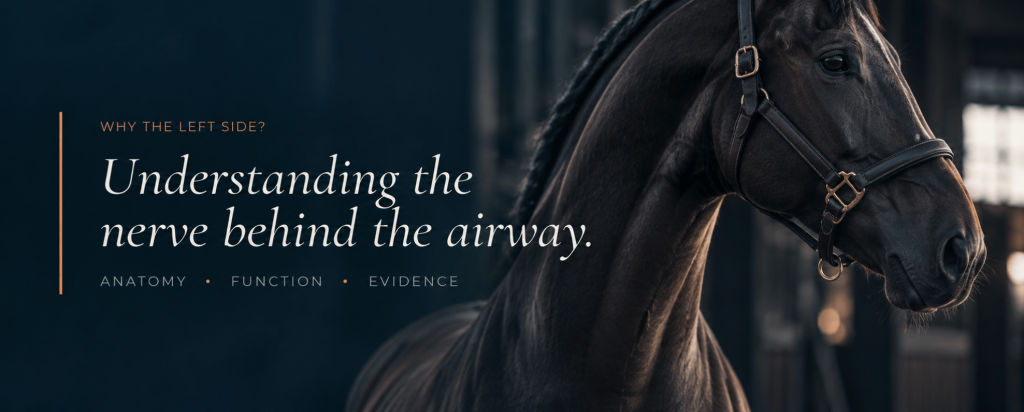
The underlying problem does not originate primarily in the vocal fold itself, but in the nerve supply controlling the muscles of the larynx.
The nerve involved is the recurrent laryngeal nerve, a branch of the vagus nerve.
On the left side, this nerve follows an unusually long anatomical route. Its fibres travel into the chest, loop around the aortic arch and then return along the trachea towards the larynx.
On the right side, the recurrent laryngeal nerve follows a shorter route around the right subclavian artery.
Consequently, the left recurrent laryngeal nerve is considerably longer than its counterpart on the right.
In classical recurrent laryngeal neuropathy, progressive degeneration of nerve fibres interferes with the normal activation of the muscles responsible for opening the arytenoid cartilage.
Over time, these muscles may partially waste away, a process known as muscular atrophy.
The precise reason for this nerve degeneration is not yet fully understood.
Research indicates that genetic factors contribute to susceptibility, while the distinctive anatomy of the left recurrent laryngeal nerve may help explain why this side is predominantly affected.
For a more detailed explanation of the underlying anatomy and clinical findings, see the Merck Veterinary Manual — Laryngeal Hemiplegia in Horses.
The characteristic respiratory sound is often the first sign people associate with roaring in horses.
However, it is important to distinguish between an audible abnormality and a functional limitation.
A horse may display some degree of laryngeal asymmetry while continuing to perform normally.
As long as the airway remains sufficiently open, a mild abnormality does not necessarily result in noticeable exercise intolerance.
More severe cases present a different situation.
When the affected arytenoid cartilage and vocal fold move further into the airway during inspiration, the space available for airflow becomes restricted.
This increases resistance, making it more difficult for the horse to move sufficient air during demanding exercise.
In severe cases, the condition may contribute to reduced athletic performance and exercise intolerance.
The consequences depend on the severity of the disorder and the demands of the particular discipline.
A racehorse galloping at maximum speed has very different respiratory requirements from a horse working predominantly at lower intensity.
Nevertheless, severe laryngeal dysfunction can also influence performance in dressage, showjumping and other equestrian disciplines.
This is a particularly important consideration when evaluating young stallions.
The absence of an audible respiratory noise does not automatically mean that the larynx is functioning normally.
During an endoscopic examination, a veterinarian may identify differences in symmetry, mobility or the ability of the arytenoid cartilages to open completely, even when the horse has never produced an obvious roaring sound.
For this reason, listening to a horse’s breathing alone is not sufficient when evaluating the respiratory function of a prospective breeding stallion.
The KWPN therefore uses laryngoscopy, an examination in which a flexible endoscope is introduced through the nostril to visualise the pharynx and larynx.
This allows abnormalities to be identified that might otherwise remain undetected during routine observation.
During a laryngoscopic examination, the veterinarian assesses several aspects of laryngeal function.
These include the movement and symmetry of the arytenoid cartilages and vocal folds.
A normally functioning larynx should demonstrate appropriate movement on both sides, with sufficient opening of the airway during inspiration.
The examining veterinarian assesses whether both arytenoid cartilages move, whether adequate abduction can be achieved and whether there are indications of impaired nerve function.
Different techniques may be used to assess laryngeal movement.
One recognised technique is the laryngeal adductor reflex test, commonly called the slap test.
During this procedure, a reflex is stimulated while the veterinarian observes the larynx through the endoscope.
The resulting movement can provide additional information about the relevant neural pathways, although it should not be interpreted as a definitive test on its own.
The KWPN has described several relevant aspects of its laryngeal assessment, including symmetry, mobility, the ability to open and close appropriately, the response to the slap test and the presence of any additional abnormalities.
Several grading systems are used to describe laryngeal function in horses.
Internationally, the Havemeyer grading system is commonly used during resting endoscopic examinations.
This system classifies laryngeal function according to the degree of movement and symmetry observed, ranging from normal function to complete paralysis of an arytenoid cartilage.
However, this classification should not be confused with the formal veterinary assessment used by the KWPN.
The KWPN applies its own veterinary standards.
According to the KWPN Veterinary Regulations, the respiratory system must function normally, the horse must be free from roaring and its breathing should produce a normal sound both at rest and during exercise.
For breeders, it is therefore important to distinguish between an internationally recognised clinical grading system and the specific requirements applied by a studbook.
The KWPN establishes specific requirements for the respiratory examination of prospective breeding stallions.
During the examination, video footage of the larynx is obtained through laryngoscopy in accordance with the studbook’s specifications.
For stallions examined in the Netherlands, recordings may be performed at the Faculty of Veterinary Medicine, by recognised individuals or institutions operating within the relevant KNMvD laryngoscopy framework, or by a specialist in equine internal medicine, as specified in the regulations.
The resulting footage is not simply assessed by whichever veterinarian performs the examination.
For stallions, the formal evaluation is carried out by a respiratory assessment committee appointed by the KWPN.
This procedure is intended to support consistency and uniformity in the assessment of prospective breeding stallions.
An important distinction exists between early veterinary screening carried out by an owner and the official examination required by the KWPN.
Under the KWPN Veterinary Regulations applicable to this article, recordings for the official respiratory assessment must be made after 1 December in the year in which the horse turns two.
This timing is significant.
Recurrent laryngeal neuropathy can develop progressively in young horses.
The KWPN explains that changes may become apparent particularly between the second and third years of life, as the function of the affected arytenoid cartilage and vocal fold gradually deteriorates.
For this reason, the studbook does not accept recordings made too early in the horse’s development for its formal assessment.
An earlier examination showing normal laryngeal function remains valuable information.
However, especially in a young horse, it cannot provide a lifelong guarantee.
This distinction matters when evaluating young stallions.
An owner may choose to have a prospective stallion examined well before the official KWPN assessment.
Professional breeding establishments and stallion owners may use early laryngoscopy to make more informed decisions about whether to continue investing in a horse as a potential breeding stallion.
Such an examination can be valuable for internal selection.
However, when the recording is obtained before the date permitted by the KWPN, it cannot automatically be used as the official recording for the subsequent stallion selection process.
There is therefore an important difference between saying:
“This stallion has already undergone a laryngeal examination.”
And saying:
“This stallion has successfully completed the official KWPN respiratory assessment.”
As with radiographic selection, both the timing and the purpose of the examination matter.
At Maverick Stables, veterinary assessment forms part of our selection process for prospective breeding stallions from an early stage.
During spring, we arrange radiographic examinations for young stallions that we consider particularly interesting as potential breeding prospects.
Before investing further in their development as stallions, we want to gain a clearer understanding of their physical foundation.
When the radiographic findings are sufficiently encouraging and a young horse remains a suitable candidate for further stallion selection, we combine this stage with an early laryngeal examination.
At this point, the examination is deliberately used as part of our own selection process.
If a young horse already displays clearly unfavourable findings, we would rather obtain that information early.
We can then consider whether retaining him as a prospective breeding stallion remains appropriate, or whether gelding and pursuing a future as a sport horse may be the more suitable direction.
This helps us avoid investing months in keeping and preparing a young stallion, only to discover potentially significant veterinary information shortly before the official selection process.
At the same time, we remain aware of the limitations associated with examining a horse at a young age.
Even when an early laryngoscopy produces favourable findings, the official KWPN examination must still be performed later, in accordance with the applicable requirements.
For us, early laryngoscopy is therefore a selection tool, not the final stage of veterinary assessment.
Recurrent laryngeal neuropathy is frequently progressive.
Nerve function may gradually deteriorate, meaning that a young stallion initially showing almost symmetrical laryngeal movement may develop more noticeable differences between the left and right sides over time.
This explains why age plays such an important role when interpreting examination results.
The KWPN not only establishes the minimum timing for official recordings, but also places restrictions on how frequently a horse may be presented for formal respiratory assessment.
Under the regulations described here, a horse may be presented for this formal evaluation no more than once per year.
If a horse is presented again in a subsequent year, previous examinations must be disclosed, and earlier recordings are also taken into consideration in accordance with the regulations.
This helps prevent an assessment from relying exclusively on one favourable moment in the horse’s medical history.
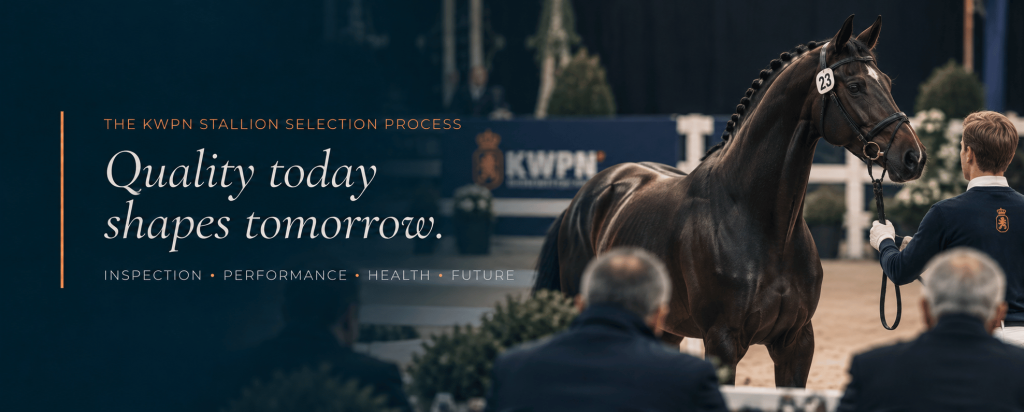
A stallion does not necessarily have to have completed his official respiratory examination at the time of the first viewing.
This is partly explained by the examination’s timing requirements.
Under the applicable KWPN regulations, official laryngoscopic recordings may only be obtained after 1 December in the year in which the horse turns two.
Consequently, breeders should be cautious about drawing conclusions from veterinary results that are either present or absent during the first viewing.
The selection process for young dressage and showjumping stallions has also changed in recent years.
Since 2025, designated three-year-old stallions have not automatically proceeded directly into the traditional spring performance testing programme.
Under certain conditions, designated young stallions may be used during their first breeding season before completing the full performance test.
To qualify, they must meet the veterinary and genetic requirements established by the KWPN.
For three-year-old stallions designated in 2026, the necessary examination results had to be submitted to the KWPN before 1 April.
These requirements included examinations such as PROK, D-OC, WFFS, semen evaluation and laryngeal assessment.
The stallion must subsequently complete the required performance testing programme successfully within the applicable selection pathway to achieve definitive KWPN approval.
Laryngeal examination is therefore not relevant only immediately before performance testing.
Under this system, respiratory screening already plays an important role for designated young stallions entering their first breeding season.
More information about the official process is available through KWPN — Stallion Selection.
As with PROK, it is important to avoid making assumptions based on missing information.
When no official laryngeal examination result is displayed for a young stallion around the time of the first viewing, this does not automatically mean that his respiratory system has never been examined.
His owner may already have arranged an earlier laryngoscopy as part of an internal selection process.
Alternatively, the official examination may simply be scheduled for a later date because of the studbook’s timing requirements.
The reverse is equally important.
A favourable early examination does not automatically establish that the stallion has definitively met the requirements of a later official KWPN assessment.
The most accurate conclusion is therefore relatively straightforward:
We only know what has actually been officially confirmed or published.
Anything beyond that requires additional information.
The official veterinary assessment process evaluates the submitted endoscopic recording.
If the footage is technically insufficient to allow a reliable assessment, an additional examination or new recording may be necessary.
The KWPN Veterinary Regulations also describe the procedures applicable when an owner wishes to challenge an official veterinary assessment.
The Dutch source article refers to an appeal period of ten days following communication of the examination result. Because appeal periods and procedures are regulatory matters, this detail must be confirmed against the current official regulations before it is relied upon.
The central principle is that veterinary examinations must be assessed using the appropriate procedures and evidence.
For prospective breeding stallions, an isolated recording should not be interpreted without considering the requirements of the relevant assessment programme.
From a breeding perspective, this is perhaps the most important question.
It is also a question for which an overly simple answer would be misleading.
Recurrent laryngeal neuropathy has a hereditary component, but it is not a straightforward single-gene disorder.
Genetic susceptibility is complex, involving multiple genes and potentially additional factors influencing the horse during development.
Modern genetic research supports this understanding.
Studies involving Warmblood horses have identified genomic regions associated with recurrent laryngeal neuropathy.
Research involving Thoroughbreds has also demonstrated a measurable genetic component and identified genomic regions potentially associated with increased susceptibility.
A particularly relevant example is the scientific publication:
This research contributes to our understanding of genetic susceptibility and the biological pathways potentially involved in recurrent laryngeal neuropathy.
It does not mean that breeders can currently perform a single DNA test and reliably predict whether an individual horse will develop the condition.
The genetic architecture is considerably more complex.
However, it does mean that the selection of breeding animals can influence the prevalence and genetic risk of the condition within a population.
For responsible sport horse breeding, this distinction is particularly important.
One interesting relationship frequently discussed in connection with recurrent laryngeal neuropathy is the association with body size.
Larger horses appear, on average, to have a greater susceptibility to RLN than smaller horses.
Longer necks have also been associated with increased risk in some veterinary research.
Genetic studies have identified relationships between body size and susceptibility to recurrent laryngeal neuropathy.
However, this does not mean that a large horse will automatically develop the condition, or that a smaller horse cannot be affected.
Body size is a potential risk factor, not a diagnosis.
This is especially relevant in modern sport horse breeding, where breeders may deliberately select for greater size and presence while also striving to improve health, soundness and long-term athletic durability.
No.
Although classical left-sided recurrent laryngeal neuropathy has an established genetic component, impaired laryngeal function can also result from other causes.
Damage to the recurrent laryngeal nerve may occur following certain injuries or diseases affecting the neck, guttural pouches or surrounding structures.
Some infectious processes and damage involving nearby blood vessels may also contribute to secondary nerve dysfunction.
For this reason, an individual abnormality must always be interpreted within its veterinary context.
Reduced laryngeal function does not automatically have the same underlying cause in every horse.
Nevertheless, classical recurrent laryngeal neuropathy remains particularly relevant to population-level breeding selection because genetic susceptibility is one of the factors involved.
Most routine laryngeal examinations are performed while the horse is standing at rest.
However, the conditions affecting airflow change substantially during intense exercise.
As respiratory demand increases, much greater volumes of air must pass through the upper airway.
The negative pressure generated during inspiration also becomes stronger.
Structures that appear relatively stable at rest may behave differently when the horse is working.
For example, when a horse produces a noticeable respiratory noise during exercise or experiences unexplained performance difficulties despite inconclusive resting findings, dynamic endoscopy may be considered.
During this examination, the endoscope remains in position while the horse exercises, allowing the veterinarian to observe laryngeal function under more realistic conditions.
Modern portable equipment makes it possible to perform overground endoscopy while the horse is being ridden or otherwise exercised.
Dynamic endoscopy can therefore provide valuable diagnostic information.
However, it should not be confused with the standard official KWPN laryngeal examination for young stallions.
For further information, see the Merck Veterinary Manual — Laryngeal Hemiplegia in Horses.
Yes.
Several surgical techniques are available for horses affected by laryngeal dysfunction.
The most appropriate treatment depends on the severity of the condition, the clinical signs and the horse’s intended athletic use.
One well-known procedure is the tie-back operation, medically referred to as prosthetic laryngoplasty.
During this procedure, the affected arytenoid cartilage is surgically held in a more open position to improve airflow during exercise.
Other surgical techniques may be used to reduce respiratory noise or address particular structures within the larynx.
More information about surgical and diagnostic approaches can be found in the Merck Veterinary Manual — Laryngeal Hemiplegia in Horses.
However, the fact that a condition can be treated surgically does not eliminate its relevance to breeding decisions.
Surgical treatment does not automatically change the underlying genetic susceptibility of the horse.
It is therefore important to distinguish between two separate questions:
Can this individual horse function successfully as a sport horse after treatment?
And:
Do we want to increase the frequency of this susceptibility within a breeding population?
These are fundamentally different considerations.
Previous veterinary treatments are also relevant when a stallion is presented for KWPN inspection or assessment.
The KWPN Veterinary Regulations contain requirements concerning disclosure of veterinary treatments that may affect the assessment of a horse’s physical condition.
These requirements extend beyond respiratory conditions and do not apply exclusively to laryngeal hemiplegia.
Where a horse has undergone a relevant veterinary intervention, the owner must comply with the disclosure requirements applicable to the inspection or selection programme.
This may include written notification and appropriate recording of treatments in the horse’s documentation.
For a stallion that has previously undergone respiratory surgery, the relevant medical history must be considered in accordance with the applicable rules.
It is important not to assume that successful surgical treatment makes the underlying veterinary history irrelevant to a future breeding assessment.
Because disclosure deadlines and procedures may change, breeders and owners should always consult the current official KWPN Veterinary Regulations.
The considerations surrounding an individual sport horse can differ considerably from those involving a prospective breeding stallion.
A sport horse with a mild abnormality may continue to perform successfully for many years without substantial problems.
Even when treatment becomes necessary, modern veterinary medicine offers several possible approaches.
However, a breeding stallion has an additional role.
A successful sire may influence hundreds or even thousands of descendants.
When a condition has a hereditary component, the question is therefore not simply whether an individual horse can function with it.
Breeders must also consider whether increasing the prevalence of that susceptibility within the breeding population is desirable.
The KWPN has a long history of assessing respiratory health during stallion selection.
The underlying principle remains relevant today:
Veterinary treatment may help an individual horse, while breeding selection aims to reduce inherited health risks in future generations.
As with PROK, it is important not to interpret a veterinary result as providing more certainty than it actually does.
A normal laryngoscopic examination provides valuable information about laryngeal function at the time of assessment.
However, the significance of that result depends partly on the age and history of the horse.
A mature sport horse with several years of successful performance and no respiratory difficulties presents a different clinical history from a two-year-old stallion examined early in his development.
In young horses, physical and neurological development is still ongoing.
We therefore consider a favourable early laryngoscopy a positive finding, but never an absolute guarantee that changes cannot occur later.
This is precisely why the timing of the official KWPN respiratory examination matters.
At Maverick Stables, we aim to incorporate veterinary information into our breeding and selection decisions as early as reasonably possible.
At the same time, we recognise that no single examination can provide a complete picture of a horse’s future health or athletic potential.
When we seriously consider retaining a young colt as a prospective breeding stallion, we want to understand more about his physical foundation before beginning a lengthy preparation process.
For that reason, we combine our spring radiographic screening with an early laryngeal examination when the horse remains sufficiently promising as a stallion prospect.
We do not do this because an early examination replaces the official KWPN assessment.
Nor do we believe that favourable findings at a young age provide absolute certainty about future laryngeal function.
We do it because access to meaningful veterinary information helps us make more informed decisions.
If a horse ultimately proves unsuitable for a future as a breeding stallion, that does not necessarily diminish his potential value as a sport horse.
The requirements we place on an animal that may contribute genetically to the next generation are different from those used to assess whether an individual horse can enjoy a successful athletic career.
For us, that distinction matters.
Veterinary selection in breeding is not simply about asking:
“Can this horse perform?”
It is also about asking:
“Which characteristics do we want to pass on responsibly to the next generation?”
That is why laryngeal examinations are not merely another veterinary box to tick within our breeding programme.
They form part of a much broader approach to health, long-term soundness and thoughtful breeding decisions.
This article provides general information about laryngeal hemiplegia, recurrent laryngeal neuropathy, veterinary screening and stallion selection.
It is not intended to replace an examination, diagnosis or professional advice from a qualified veterinarian.
The significance of laryngoscopic findings must always be evaluated in relation to the individual horse, including its age, clinical signs, intended use and complete veterinary history.
Information concerning KWPN veterinary requirements is provided for general educational purposes. For official procedures, deadlines and eligibility requirements, always refer to the regulations applicable to the relevant selection year.
This article draws on established veterinary references and peer-reviewed scientific research into equine laryngeal hemiplegia, also known as roaring in horses.
Merck Veterinary Manual — Laryngeal Hemiplegia in Horses
A professional veterinary reference explaining recurrent laryngeal neuropathy, its clinical signs, diagnosis through endoscopy, respiratory function and available surgical treatment options.
Merck Veterinary Manual — Disorders of the Larynx in Horses
An accessible veterinary overview of equine laryngeal disorders, including roaring, airway obstruction and exercise intolerance.
Published in Equine Veterinary Journal. This genome-wide association study investigates genetic susceptibility to recurrent laryngeal neuropathy in Thoroughbred horses and identifies a candidate gene associated with myelin structure.
Official Journal Publication — Equine Veterinary Journal
The publisher’s version of the McGivney et al. (2025) scientific study.
The Royal Dutch Warmblood Studbook (KWPN) publishes veterinary regulations and information about respiratory examinations within its stallion selection programme.
These official publications establish the requirements applicable to prospective breeding stallions, including the assessment of respiratory function, examination procedures and relevant submission deadlines.
The latest KWPN Veterinary Regulations and the stallion selection requirements for the relevant year should be consulted directly before making decisions about participation.
Please note: Veterinary regulations and stallion selection requirements may change. Always consult the latest official KWPN regulations and requirements applicable to the relevant selection year.