Every breeding programme has a beginning. Ours was built upon generations of agricultural experience, a passion for genetics and the ambition to establish a strong maternal foundation.
The origins of Maverick Stables can be traced back long before the Maverick name was introduced. Our family’s experience in breeding began within dairy farming, where genetics, pedigree analysis and selective breeding were already essential parts of our approach to developing and improving livestock.
Working with dairy cattle had given us an understanding of how breeding decisions influence future generations. The importance of maternal families, genetic diversity, performance and the careful selection of breeding partners was therefore already familiar to us when our interest expanded into sport horse breeding.
Although breeding horses presented different challenges and required additional knowledge, our underlying philosophy remained the same. We wanted to build a breeding programme upon a strong genetic foundation, with particular attention to the quality of the maternal line and its potential for future generations. Rather than beginning with just any mare, our ambition was to establish our breeding activities with a horse whose pedigree and individual qualities offered a promising foundation.
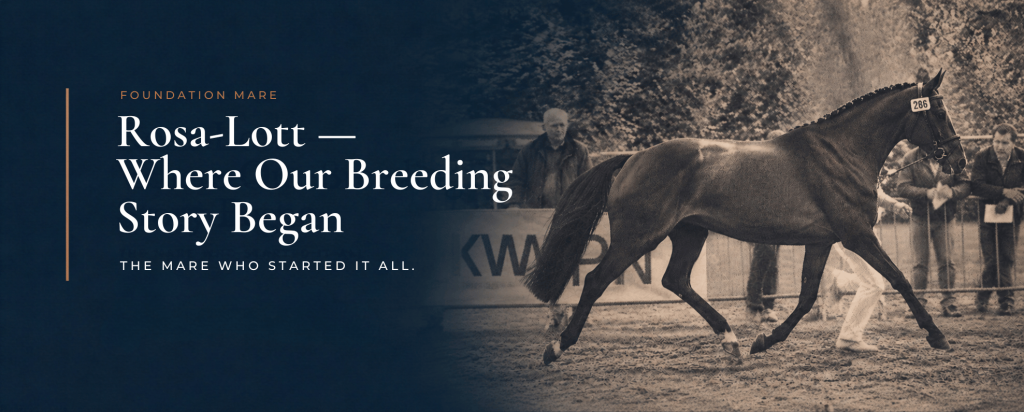
That mare was Rosa-Lott.
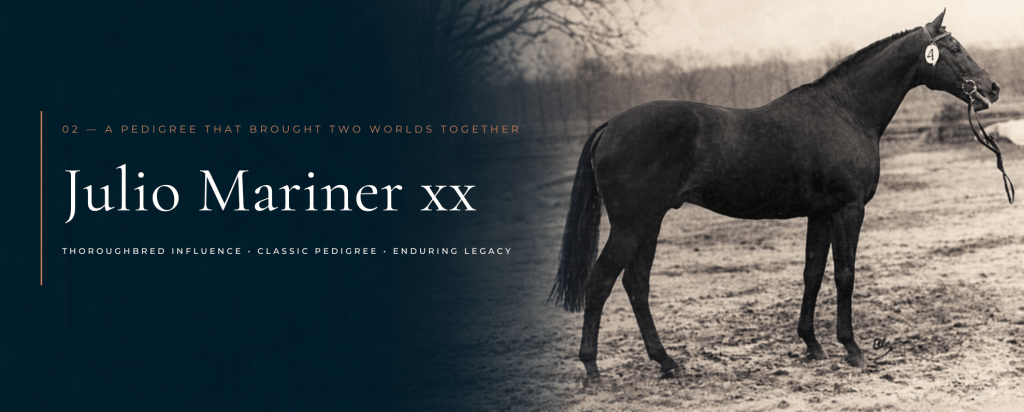
Born in 1998, Rosa-Lott was a daughter of the Thoroughbred stallion Julio Mariner xx out of Zofia, a daughter of the Holsteiner stallion Saluut. Her pedigree brought together established European sport horse bloodlines and direct Thoroughbred influence, while her maternal family offered an interesting background for further development.
Her arrival marked the beginning of our family’s sport horse breeding history, creating a foundation that would eventually become part of Maverick Stables.
For our family, the transition from breeding dairy cattle to breeding sport horses was a natural extension of an existing interest in genetics and the development of successive generations. Although the breeding objectives differed considerably between the two species, the principles of understanding pedigrees, evaluating individual qualities and making carefully considered breeding decisions remained relevant.
Our experience in dairy farming had taught us that successful breeding requires patience and a long-term perspective. The results of a particular combination cannot always be fully evaluated in the first generation, and the value of a maternal family often becomes clearer as successive generations develop.
When our father decided to take his first steps into horse breeding, establishing a strong maternal foundation was therefore an important priority. We were not simply looking for a mare with an attractive pedigree, but for a horse whose background and individual qualities could provide a meaningful starting point for a long-term breeding programme.
Rosa-Lott represented that opportunity. Her pedigree combined established Thoroughbred and warmblood bloodlines, while her own conformation, movement and subsequent inspection results provided additional information about her qualities as an individual.
With Rosa-Lott, our family’s existing breeding knowledge found a new direction. What began as an ambition to establish a carefully selected maternal line gradually developed into a breeding history that has continued across generations.
Although our facilities, experience and breeding objectives have evolved over the years, the importance of a strong genetic foundation remains unchanged. The principles that guided our earliest breeding decisions continue to influence the way we approach the selection of mares, stallions and future generations at Maverick Stables.
Rosa-Lott’s pedigree united two different traditions within European horse breeding. Through her sire, Julio Mariner xx, she carried the influence of British Classic racing, while her maternal family represented generations of established European warmblood breeding.
Julio Mariner had earned his place in British racing history when he won the St Leger Stakes in 1978. After his retirement from racing and an initial breeding career in Great Britain, he was brought to the Netherlands by veterinarian and breeder Jan Greve in 1988. At De Watermolen in Haaksbergen, he became part of a breeding philosophy that recognised the potential of Thoroughbred blood within the European warmblood population.
His own pedigree was particularly distinguished. His sire, Blakeney, had won the Epsom Derby in 1969, while his dam, Set Free, produced three British Classic winners. This family background, combined with his subsequent contribution to sport horse breeding, made Julio Mariner an interesting representative of Thoroughbred influence.
Rosa-Lott’s maternal background was equally important. Her dam, Zofia, was a daughter of Saluut, a Holsteiner stallion whose international Grand Prix career and subsequent breeding achievements had established his reputation within European sport horse breeding.
Zofia received the KWPN ster predicate and competed at Z level in showjumping. Her maternal family continued through Tironetje, by Duc de Normandie, followed by Ironetje, by Eclatant, and Uronetje, by Oran. Through these generations, Rosa-Lott belonged to an established Dutch maternal family with roots in the Gelderland horse population.
The combination of Julio Mariner and Zofia brought these different breeding backgrounds together. It united direct Thoroughbred ancestry with established Holsteiner and Dutch warmblood bloodlines, creating a pedigree that reflected several important developments within European horse breeding.
For our family, this background was particularly interesting because it offered more than a collection of recognisable stallion names. The wider pedigree provided insight into the generations of breeding decisions that had shaped Rosa-Lott’s maternal family and the different genetic influences that had been introduced along the way.
Understanding those earlier generations became an important part of our approach to breeding and remains central to the way we research pedigrees today.
The history of Rosa-Lott’s maternal family extends far beyond her immediate pedigree. Through successive generations, each mare contributed to a family whose development continues to be part of our breeding programme.
For a more detailed exploration of her ancestry, maternal family, offspring and subsequent generations, discover our Rosa-Lott Dam Line.
While Rosa-Lott’s pedigree offered an interesting foundation, her own qualities were equally important. A promising maternal family can provide valuable information, but the individual mare must also possess characteristics that make her suitable for the intended breeding objectives.
Rosa-Lott demonstrated her qualities during her early inspections. At four years old, she was presented at the local studbook inspection in IJsselmuiden, where she received a first premium and was awarded 78 points for conformation and movement.
The historical inspection report praised her appealing conformation and supple movement, qualities that contributed to her selection for the National Mare Inspection.
For our family, these results represented an important milestone. Rosa-Lott had demonstrated that her qualities extended beyond her pedigree, providing additional confidence in the foundation upon which our breeding activities were being developed.
The photographs and newspaper coverage from this period remain particularly meaningful. They offer a glimpse into an early chapter of our family’s breeding history, long before the Maverick name became associated with the horses we breed today.
Rosa-Lott’s development as a breeding mare was an important part of our family’s early breeding activities. We presented her ourselves for the IBOP jumping test, which she successfully completed with 75 points. This achievement provided valuable insight into her athletic ability and suitability for sport, complementing the promising results she had already achieved during her earlier inspections.
Over the course of her breeding career, Rosa-Lott received the elite, IBOP-(SPR) and D-OC predicates. These recognitions reflected different aspects of her individual qualities, performance and health-related assessment within the KWPN system.
Her preferent predicate, however, was an achievement of a different nature. Unlike the results she obtained through her own inspections and performance test, this recognition was awarded on the basis of the qualities and inspection results of her offspring. It demonstrated that her value extended beyond her individual characteristics and was also reflected in the next generation.
For our family, this distinction was particularly meaningful. Having personally presented Rosa-Lott for her IBOP test, we had experienced her individual qualities firsthand. Seeing her later receive the preferent predicate through her offspring added another dimension to her breeding legacy.
Her achievements illustrate the importance of evaluating a breeding mare from more than one perspective. While individual inspections and performance tests provide valuable information, the quality of her offspring offers further insight into her contribution to future generations.
For a family with an existing background in selective breeding, this longer-term perspective was particularly important. Our ambition was never simply to own a successful mare, but to establish a maternal family that could be developed and evaluated across successive generations.
The true significance of a foundation mare often becomes apparent only after several generations. While Rosa-Lott’s own inspection results established her qualities as an individual, her lasting contribution to our family would ultimately be found in the descendants through whom her bloodlines continued.
Each generation brought new breeding decisions and opportunities to evaluate the family. Different stallions introduced their own genetic backgrounds, while the maternal line provided continuity between the horses that followed.
This continuity is particularly valuable within a breeding programme. By maintaining a maternal family over several generations, breeders have the opportunity to observe how individual characteristics develop, recognise qualities that may repeatedly emerge and evaluate the results of previous breeding combinations.
For our family, the development of Rosa-Lott’s descendants gradually transformed an initial breeding ambition into a history that could be followed across generations. Her offspring and later descendants each contributed their own chapter, whether through their sporting development, their individual qualities or their contribution to subsequent breeding decisions.
Among the horses that became part of this history were Harry and Prestige Maverick S, whose individual development provided further opportunities to observe the family.
Prestige Maverick S, a daughter of Cohinoor VDL out of Rosa-Lott, represents a direct continuation of the maternal line within our breeding programme. Through Prestige, the connection with our first broodmare remains part of the future of Maverick Stables.
The continuation of this family is particularly meaningful because it allows us to build upon the knowledge gained from previous generations. Rather than assessing a breeding combination solely through the immediate foal, we can follow the development of the family over time and consider how different genetic influences contribute to the horses that follow.
Maintaining this connection with earlier generations also gives our breeding programme a sense of continuity. Rosa-Lott’s descendants are not simply individual horses with a shared ancestor; together, they represent the development of a maternal family that began with our father’s first breeding decisions.
One of the most valuable aspects of following a maternal family over several generations is the opportunity to observe qualities that are not always fully reflected in inspection reports, competition results or the names appearing in a pedigree.
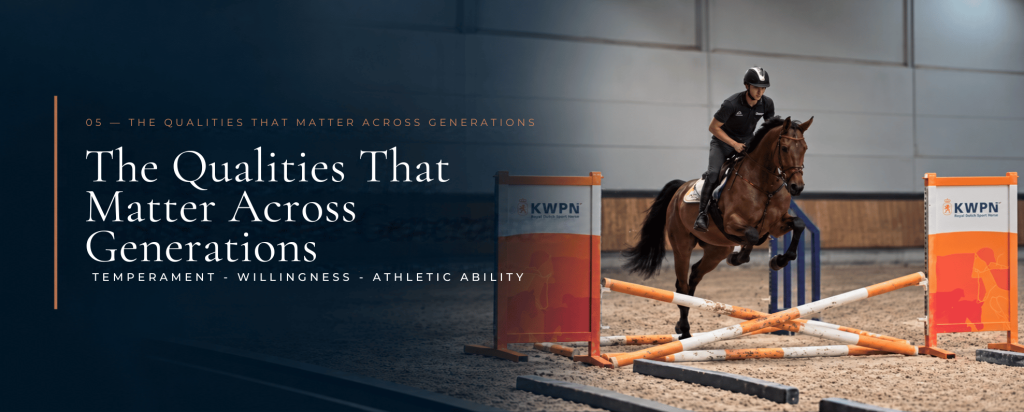
Within Rosa-Lott’s family, willingness to work and a cooperative attitude have been characteristics that our family particularly values. These qualities influence how a horse responds to training, develops in partnership with its rider and approaches the challenges associated with equestrian sport.
Temperament and willingness are complex characteristics that are influenced by both genetics and the environment in which a horse develops. They cannot be guaranteed through a particular pedigree or expected to appear identically in every descendant. Nevertheless, following a family over time provides valuable opportunities to recognise qualities that may repeatedly emerge.
Our experience in dairy cattle breeding had already taught us the importance of considering more than an animal’s most immediately visible characteristics. Performance, health, functionality and the ability to maintain desirable qualities across generations all contribute to the long-term value of a breeding family.
Within sport horse breeding, these principles take on a different practical meaning, but they remain equally important. Athletic ability and sporting potential are essential considerations, yet they must be evaluated alongside temperament, conformation, soundness and the individual characteristics of both parents.
Our approach therefore involves more than selecting a stallion because of his popularity, pedigree or individual sporting achievements. We consider how his qualities may complement those of the mare and whether the proposed combination supports our longer-term breeding objectives.
Sometimes the aim is to preserve characteristics that have already proven valuable within a family. In other cases, introducing a different bloodline may offer opportunities to strengthen particular qualities or broaden genetic diversity.
The history of Rosa-Lott reminds us that breeding is not about reproducing the same horse in every generation. It is about understanding the characteristics of a family, recognising its strengths and limitations, and making thoughtful decisions about how it may develop in the future.
Rosa-Lott belonged to a chapter of our family’s breeding history that began long before Maverick Stables took its present form. What started with our father’s ambition to establish a carefully selected maternal line gradually developed into a broader commitment to sport horse breeding.
Over the years, our experience grew, the horses and facilities changed, and our breeding objectives continued to develop. Nevertheless, the underlying principles remained closely connected to the knowledge that had originally come from our agricultural background: understanding genetics, evaluating individual qualities and approaching breeding with a long-term perspective.
Today, our breeding philosophy is built around the individual mare. We study her pedigree and maternal family alongside her conformation, health, temperament, performance and genetic background. Each breeding decision is made with consideration for the qualities we hope to preserve, the characteristics we wish to improve and the potential contribution of the resulting offspring to future generations.
These principles form the foundation of our approach at Maverick Stables, where responsible breeding, genetic diversity and the long-term development of the horse remain central to every decision. Discover more about the principles behind our breeding programme in Our Breeding Philosophy.
This approach also requires patience. The true value of a breeding decision may not become apparent until a horse reaches maturity or begins its sporting career. In some cases, the influence of a particular combination may only become visible through the next generation.
The history of Rosa-Lott reflects precisely this longer-term perspective. Her importance cannot be measured solely through her own achievements, but through the family she established and the opportunities her descendants continue to offer.
Although Rosa-Lott is no longer with us, the generations she left behind remain part of our story. Through her descendants, the connection between our father’s first breeding decisions and the future of Maverick Stables continues.
She represents the beginning of a journey in which our family’s agricultural experience, knowledge of genetics and passion for horses came together to create something that would endure across generations.
Every breeding programme has a beginning. For our family, that beginning will always be Rosa-Lott.
Discover her complete pedigree, maternal family, offspring and the generations that continue her legacy at Maverick Stables.