A responsible approach to parasite monitoring, targeted treatment and long-term horse health
Internal parasites are part of keeping horses. Complete elimination is neither a realistic nor a sensible goal. What matters is preventing parasite burdens from becoming harmful while at the same time preserving the effectiveness of the deworming treatments available to us.
For many years, horses were routinely dewormed according to a fixed calendar. Every six or eight weeks another treatment was administered, often to every horse on the yard regardless of age, management or actual parasite burden.
Today, we know that parasite control requires a much more considered approach.
In the Netherlands, veterinary guidance has increasingly moved towards selective treatment based on diagnostic testing, the individual horse and its management conditions, rather than automatically treating every horse at fixed intervals. Paardenarts.nl likewise advises that parasite-control strategies should be tailored to the horse and the circumstances in which it is kept.
At Maverick Stables, this fits closely with the way we approach preventive horse management in general.
Test where testing is appropriate. Understand the result. Treat when there is a reason to do so.
Almost every grazing horse will encounter internal parasites during its life. Eggs and larvae form part of the environment in which horses graze, and exposure cannot realistically be prevented altogether.
The aim of a good parasite-control programme is therefore not to create a completely parasite-free horse.
Instead, the objective is to prevent clinically significant parasite burdens, reduce unnecessary pasture contamination, identify horses that contribute disproportionately to egg shedding and protect animals that are particularly vulnerable, such as foals and young horses.
At the same time, we have another responsibility: preserving the effectiveness of the anthelmintic drugs we still have available.
Repeated exposure to dewormers creates selection pressure within parasite populations. Susceptible worms are removed, while resistant individuals are more likely to survive and reproduce. Over time, this can lead to increasingly resistant parasite populations.
Dutch and international veterinary recommendations therefore discourage blindly deworming all horses throughout the year according to fixed intervals.
Good parasite control is no longer simply about how often we treat.
It is about understanding whether treatment is necessary, what we are trying to treat and whether the chosen treatment remains effective.
Traditional deworming schedules were designed during a period when highly effective anthelmintics were widely available and resistance was far less common.
Today, the situation is different.
Resistance among equine parasites — particularly small strongyles — has become an important concern internationally, with widespread resistance reported against some classes of anthelmintic drugs and increasing concern regarding reduced effectiveness of others.
Treating unnecessarily applies additional selection pressure.
Every time a population of worms is exposed to an anthelmintic, susceptible parasites are removed while parasites carrying resistance traits are more likely to survive and reproduce.
Over time, repeated unnecessary treatment can therefore contribute to the development of resistant parasite populations.
This is why responsible parasite management asks a different question.
Not:
“When is the next wormer due?”
But:
“Does this horse require treatment, and if so, what are we trying to treat?”
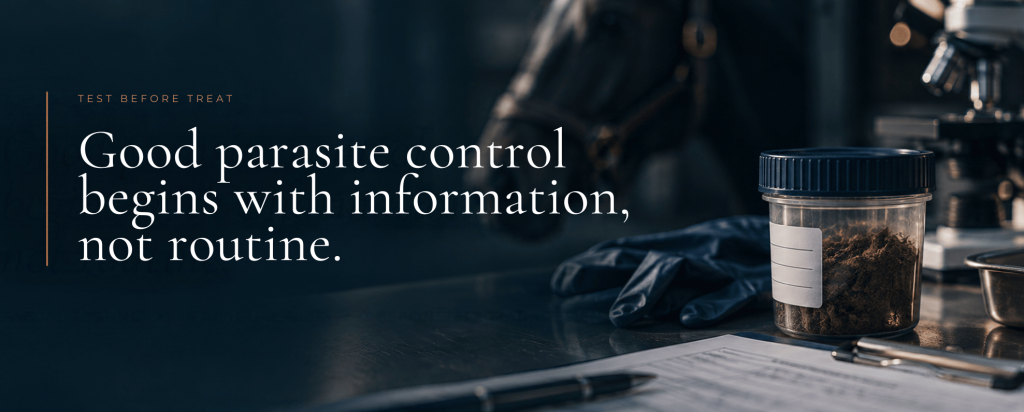
Faecal egg counting is one of the most useful tools available for monitoring parasite shedding. A manure sample is examined for parasite eggs and the result is expressed as the number of eggs per gram of faeces, usually abbreviated to EPG.
This gives us information about how much a horse is contributing to environmental contamination at that moment.
The important point is that horses are not all equal in this respect. Some adult horses repeatedly shed very few strongyle eggs, while others consistently shed considerably larger numbers. By identifying these differences, parasite management can become much more individual.
Paardenarts.nl recommends faecal testing as an important basis for selective deworming in adult horses rather than treating every horse according to the same fixed calendar. For horses over three years of age, testing several times during the grazing season may form part of an individual parasite-control programme.
At Maverick Stables, this principle makes sense to us. A mature horse that repeatedly demonstrates low egg shedding should not automatically be managed in exactly the same way as a horse that consistently contaminates the environment more heavily.
However, a faecal egg count must be interpreted correctly.
It measures egg shedding. It does not directly tell us how many worms are living inside the horse, nor does it reliably detect every parasite or every life stage.
Timing also matters.
In autumn and winter, some parasites may reduce or stop egg production. As Paardenarts.nl points out, this means that a negative faecal egg count later in the year can be falsely reassuring. The result may simply indicate that no eggs were being shed at the time of sampling — not that the horse is completely free from parasites. Paardenarts
For us, a faecal egg count is therefore an important management tool, not a complete diagnosis in isolation.
One of the main limitations of parasite testing is that no single diagnostic method can reliably identify every internal parasite affecting horses. A routine faecal egg count is extremely useful, but only when we understand what it can and cannot tell us.
For strongyles, faecal egg counts are an important monitoring tool because they help us estimate how much a horse is contributing to pasture contamination. In younger horses, roundworm eggs may also be detected this way. However, other parasites behave very differently, and their biology makes them much harder to assess through an ordinary manure sample.
Tapeworms are a good example. Their eggs are not necessarily shed consistently, which means a horse can carry tapeworms while a conventional faecal sample still appears negative. Pinworms present another challenge because their eggs are deposited around the anus rather than being reliably passed in the manure. Encysted small strongyles can also remain within the intestinal wall without producing eggs at all.
This is particularly relevant later in the year. During autumn and winter, parasite activity changes and some stages become much more difficult to detect through routine egg counting. Dutch veterinary guidance therefore stresses that a negative manure result should not automatically be interpreted as proof that a horse is parasite-free. (paardenarts.nl)
That distinction is important to us, because “test before we treat” should never be interpreted too literally. The purpose of testing is not to create a rigid rule in which every treatment must be preceded by a positive manure sample. The purpose is to gather the right information and use the most appropriate diagnostic method for the parasite, the season and the individual horse.
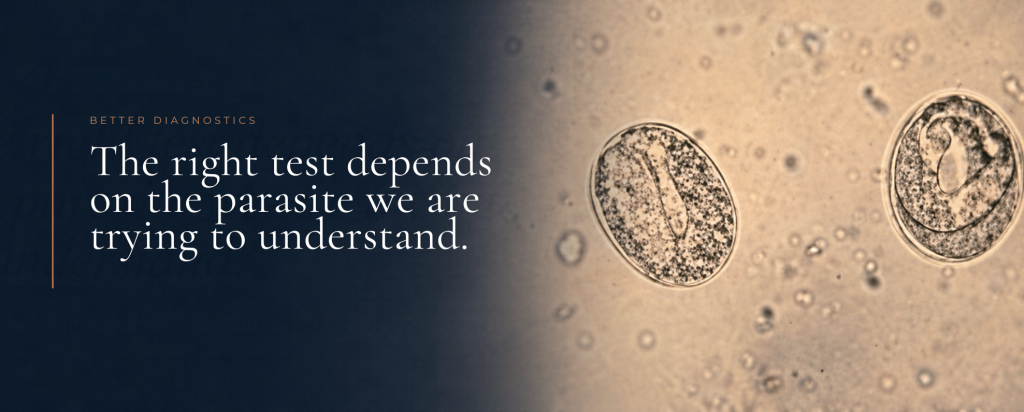
Tapeworm is one of the clearest examples of why modern parasite control needs more than routine faecal egg counts alone.
The equine tapeworm Anoplocephala perfoliata attaches primarily around the junction between the small intestine and caecum. Because tapeworm eggs are released irregularly, they may be missed during conventional manure examination. A negative faecal test therefore does not necessarily exclude a tapeworm burden.
Historically, this uncertainty is one of the reasons why tapeworm treatment was often included more routinely in autumn parasite programmes. However, as parasite management becomes increasingly selective, there is a growing need for diagnostic tools that can provide more specific information before treatment.
Saliva antibody testing offers one such option. Rather than looking for parasite eggs directly, it assesses the horse’s immune response to tapeworm exposure. That gives veterinarians and horse owners another source of information when deciding whether treatment is appropriate.
For us, this is exactly the direction in which responsible parasite management should move. The aim is not to avoid treatment at all costs, but to make treatment decisions with as much relevant information as possible.
Pinworms demonstrate even more clearly why the diagnostic method needs to match the biology of the parasite.
Adult female Oxyuris equi migrate towards the anus and lay their eggs in a sticky substance on the surrounding skin. Because those eggs are deposited outside the intestinal tract, they are not consistently present in the manure. A horse can therefore show typical signs of pinworm infection while a routine faecal egg count remains negative.
Often, the first indication is not a laboratory result but a change in the horse’s behaviour. Persistent tail rubbing, itching around the base of the tail and damaged tail hairs can all raise suspicion.
In those cases, an adhesive tape preparation taken from the skin around the anus can be far more useful than another routine manure sample.
For us, this reinforces an important point: good diagnostics are not about testing for the sake of testing. They are about asking the right question and then choosing the test most likely to answer it.
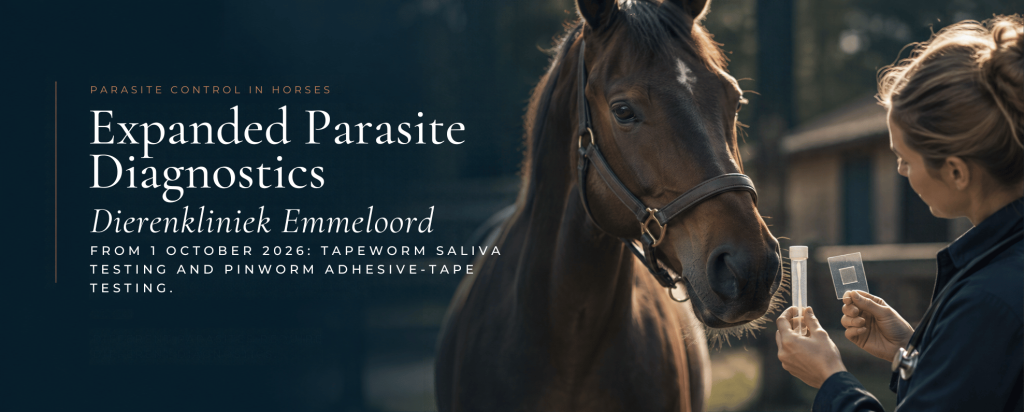
From 1 October 2026, Dierenkliniek Emmeloord expanded the parasite diagnostics available alongside conventional faecal testing.
Until now, routine manure examination has mainly focused on bloodworms and roundworms. For tapeworms and pinworms, however, standard faecal examination is less reliable.
The clinic now offers additional testing for both.
Tapeworm exposure can be investigated by measuring antibodies in the horse’s saliva. According to Dierenkliniek Emmeloord, this can be carried out annually where appropriate. For horses showing signs suggestive of pinworms, such as persistent itching around the tail head, a simple adhesive tape preparation can be used to investigate whether pinworm eggs are present.
For us, this is a valuable development because it adds another layer to the decision-making process. Instead of treating blindly for parasites that may or may not be present, it becomes possible to gather more specific information and then decide, together with the veterinarian, whether treatment is actually indicated.
That fits closely with the way we approach preventive care at Maverick Stables. We would rather understand the situation first and intervene with a clear reason than treat routinely without knowing whether that treatment is necessary.
Autumn is the point in the year when parasite control becomes more complicated.
During the main grazing season, faecal egg counts can give us valuable information about strongyle egg shedding. Later in the year, however, that picture becomes less complete. Some parasites enter stages in which they produce few or no eggs, while others are simply difficult to detect through routine manure examination.
Encysted small strongyles are particularly important in this respect because they can remain within the intestinal wall without contributing to the faecal egg count. Tapeworm and bot larvae also require separate consideration.
For that reason, Dutch veterinary guidance treats autumn parasite management as a separate issue rather than simply continuing the same testing strategy used during spring and summer. (paardenarts.nl)
This is where the principle “test before we treat” needs some nuance. Testing remains extremely valuable, but a negative manure result in autumn does not automatically mean that treatment is unnecessary.
The decision has to take into account the whole horse: age, grazing history, previous egg counts, treatment history, clinical signs and the parasites that are relevant at that point in the year.
In some cases, the most responsible decision may be not to treat. In others, treatment may still be justified despite a low or negative routine faecal result.
Parasite management in foals and young horses deserves particular attention because their immune system has not yet developed the same level of acquired resistance seen in many adult horses.
This makes them more vulnerable to certain parasites, especially roundworms such as Parascaris. Heavy burdens can interfere with growth and condition and, in severe cases, contribute to serious intestinal complications.
That is why a parasite-control programme designed for a mature broodmare or sport horse should never simply be copied onto a foal or yearling.
Dutch veterinary guidance also distinguishes young horses from mature horses because their risk profile is different and because not every treatment strategy is appropriate at every age. (paardenarts.nl)
For us, this is especially relevant because youngstock management forms such an important part of the yard. Age, development, previous treatment and origin all influence the way we interpret testing and decide whether treatment is necessary.
The principle remains the same: use information to guide the decision. But the way that principle is applied must change with the horse.
A new horse entering a yard brings more with it than its passport and vaccination history.
It may also bring a completely different parasite history.
A horse arriving from another stable, breeding farm or country may have been treated under a very different management system. It may have received frequent deworming, very little treatment, or products that are no longer fully effective against the parasite population it carries.
That does not mean a newly arrived horse should automatically be regarded as a risk. It simply means that assumptions are unhelpful.
Reviewing previous treatment, considering faecal testing and discussing follow-up with the veterinarian can provide much more useful information than simply adding the new horse to the existing yard routine.
For a breeding and rearing yard, this is particularly relevant because horses may arrive from different regions and countries. Each horse brings its own background, and parasite management is one more area where that background matters.
One of the most important lessons from anthelmintic resistance is that administering a dewormer does not automatically mean the treatment has worked as expected.
A product may have been dosed correctly and still fail to reduce egg shedding sufficiently because the parasite population has developed resistance.
That is where a Faecal Egg Count Reduction Test can become useful.
A faecal egg count is performed before treatment and repeated afterwards at the appropriate interval. By comparing the two results, it becomes possible to estimate how effectively the product has reduced egg shedding.
This changes parasite management in an important way. Instead of assuming that the treatment was successful, we can actually evaluate it.
Paardenarts.nl also recommends follow-up testing in situations where treatment effectiveness needs to be assessed, while international guidelines such as those of the AAEP emphasise monitoring drug efficacy within a yard or herd. (paardenarts.nl)
For us, that is a logical extension of the same philosophy: if we decide to treat, we should also be willing to ask whether the treatment achieved what we intended.
One of the less intuitive ideas in modern parasite control is the concept of refugia.
Refugia refers to the part of the parasite population that is not exposed to a dewormer at a particular moment.
At first, the idea of intentionally leaving some parasites unexposed can sound counterproductive. But from a resistance perspective, it is extremely important.
When every parasite is repeatedly exposed to the same treatment, any resistant worms gain a strong biological advantage. Susceptible parasites are removed, while resistant ones survive and reproduce.
By avoiding unnecessary treatment in horses that do not require it, susceptible parasites remain part of the wider population. Those susceptible genes help dilute resistant ones and may slow the development of widespread resistance.
This does not mean accepting poor parasite control. It means understanding that more treatment is not always better treatment.
The goal is to treat when there is a reason to do so, while preserving the effectiveness of the medication for the horses that genuinely need it.
Medication is only one part of parasite control.
The environment in which horses live has an enormous influence on the level of infection pressure they experience.
Strongyle eggs are passed in manure and, under suitable conditions, develop into infective larvae on pasture. Horses then ingest those larvae while grazing.
That means the paddock itself becomes part of the parasite-control programme.
Manure management, stocking density, grazing rotation and the movement of horses between paddocks can all influence how heavily contaminated an area becomes. Paardenarts.nl therefore places clear emphasis on pasture management as an important part of reducing parasite pressure.
At Maverick Stables, we prefer to see this as part of good overall horse management rather than as a separate worm-control task.
Testing is more useful when environmental pressure is controlled. Treatment is more meaningful when reinfection is not unnecessarily encouraged. And individual monitoring becomes more valuable when the wider group and its grazing conditions are also taken into account.
One faecal egg count gives us information about one horse at one moment.
A history of results tells us much more.
Some adult horses repeatedly show low egg shedding. Others consistently contribute more heavily to pasture contamination. Young horses may show a very different pattern at first and then change as they mature and develop stronger immunity.
By recording these results over time, we can begin to recognise the individual pattern of a horse.
That makes future decisions more informed because we are no longer treating every sample as an isolated event.
For us, this reflects a wider principle in horse management. Observation is useful, but documented observation is far more valuable.
Patterns become visible only when we take the time to record them.
“Test before we treat” is a useful principle, but it should never become an inflexible rule.
A horse does not have to produce a positive routine faecal egg count before treatment can ever be justified.
There are situations in which age, season, previous history, clinical signs or known parasite risks provide a valid reason for treatment even when routine testing gives little information.
Some parasites cannot be reliably detected through a conventional manure sample. Some stages do not produce eggs. Young horses need different consideration from adults. Autumn requires a different interpretation from spring and summer.
The correct decision therefore comes from the whole picture rather than one laboratory result.
That is the distinction we consider important.
Responsible parasite control is not necessarily about treating less.
It is about treating more deliberately.
At Maverick Stables, parasite control is part of a much broader approach to preventive horse management. We do not see deworming as an isolated task, but as something that should be considered alongside age, development, grazing conditions, group composition, previous treatment, diagnostic results and the individual history of the horse. This is particularly important in a breeding and rearing environment, where the horses in our care may range from recently weaned foals to yearlings, broodmares and mature sport horses, all with very different levels of immunity and very different exposure risks.
Because of those differences, we do not believe that one fixed deworming schedule can provide the best answer for every horse. A young horse that has only recently arrived from another breeder may require a different level of monitoring from a mature mare that has been tested repeatedly over several seasons. Likewise, a horse with a consistently low faecal egg count should not automatically be managed in exactly the same way as a horse that repeatedly sheds larger numbers of eggs.
Over time, these individual patterns become valuable because they allow us to move away from assumptions and towards a management strategy that is based on what we actually know about the horse.
That is also why record keeping is so important. A single test result gives us information about one moment, but a series of results collected over time begins to tell a story. We can see whether a horse tends to remain a low shedder, whether a young horse requires closer monitoring during a certain stage of development, or whether a change in pasture, group composition or management appears to influence parasite pressure. In that sense, testing is not simply a way to decide whether to administer a dewormer; it becomes part of an ongoing process of understanding how an individual horse responds to its environment.
The same principle applies when treatment is necessary. We want there to be a clear reason behind the decision, whether that reason is a faecal egg count, age, seasonal risk, clinical signs, a specific diagnostic test or veterinary advice. At the same time, we do not want the phrase “test before we treat” to become a rigid rule. Not every parasite can be identified through routine faecal testing, and there are situations in which treatment may be justified even when an ordinary manure sample is negative. Good parasite control therefore depends on interpretation rather than simply following a laboratory result.
For us, that balance is important. Treating every horse routinely without knowing whether it is necessary can contribute to anthelmintic resistance, while relying too heavily on testing without understanding its limitations can create a false sense of security. The best approach lies somewhere between those two extremes: using diagnostics where they are useful, recognising where they are limited, monitoring the horse over time and involving the veterinarian when the situation requires a broader assessment.
This is ultimately what we mean by test before we treat. It is not about avoiding treatment, and it is not about trying to prove that every horse can go without a dewormer. It is about making treatment part of an informed decision rather than a habit. The more we know about the horse, its history and the parasite risks relevant to that moment, the better that decision can become.
A manure sample may seem like a very small part of horse management, but the information it provides can influence much more than a single treatment. Combined with additional diagnostic methods, careful observation, pasture management and individual records, it helps build a clearer picture of what is happening within a horse and within a group. Over time, that information allows parasite control to become more precise and more responsible.
For us, that is the real value of modern parasite management: protecting the horse in front of us without losing sight of the wider consequences of how we use medication. Anthelmintics remain essential veterinary tools, but their long-term effectiveness depends on using them carefully. By treating when there is a reason, testing when testing can give us useful information and continuing to evaluate whether our approach is working, we can protect individual horses while also helping preserve effective treatment options for the future.
The information contained in this article is provided for general educational purposes only. It is not intended to replace veterinary examination, diagnosis or an individual parasite-control programme developed by a qualified veterinarian.
Parasite-control strategies should be adapted to the individual horse and may vary according to age, health status, grazing conditions, season, management system, geographic location, previous treatment history and parasite risk.
Faecal egg counts and other diagnostic tests have limitations. A negative test does not exclude every parasite infection or life stage, and treatment may still be recommended in specific circumstances.
Anthelmintic products should only be used at the correct dose and following appropriate veterinary advice. Particular care is required in foals, young horses, pregnant mares and horses with suspected heavy parasite burdens.
At Maverick Stables, diagnostic results and treatment decisions are assessed in consultation with our veterinary professionals where appropriate.
For horse owners in the Netherlands, Paardenarts.nl provides useful veterinary information about faecal egg testing, selective deworming, pasture management and parasite control throughout the year. Their information also explains why autumn management needs to be considered separately from routine testing during the grazing season. Paardenarts
Paardenarts.nl — search: ontwormen
Paardenarts.nl — Mestonderzoek: de basis voor ontworming bij paarden
Paardenarts.nl — Selectief ontwormen in het najaar
Paardenarts.nl — Wormen en ontworming bij paarden
For additional international veterinary guidance, the American Association of Equine Practitioners (AAEP) publishes detailed Internal Parasite Control Guidelines covering faecal egg counts, resistance monitoring and targeted treatment.