From his victory in the 1978 St Leger Stakes to his lasting influence on European warmblood breeding, Julio Mariner xx left a legacy that extended far beyond the racecourse.
The history of European sport horse breeding is shaped not only by the stallions that achieved success in the competition arena, but also by those whose influence reached beyond the discipline for which they were originally bred. Julio Mariner xx was one of these exceptional horses. Born into a distinguished British Thoroughbred family in 1975, he began his career on the racecourse, where he would achieve one of the most prestigious victories in British Classic racing. Yet his greatest contribution to the development of the modern sport horse was still to come.
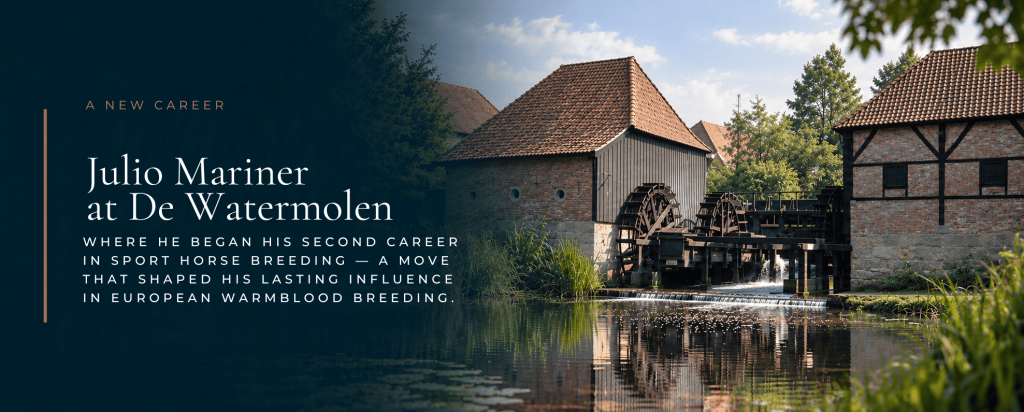
After retiring from racing, Julio Mariner initially entered the British Thoroughbred breeding industry. His career took an unexpected turn when Dutch veterinarian and breeder Jan Greve brought him to the Netherlands in 1988. At De Watermolen in Haaksbergen, he became part of a breeding philosophy that recognised the potential of Thoroughbred blood within established European warmblood families.
His descendants would eventually establish themselves in international showjumping and other equestrian disciplines, while his daughters and subsequent generations continued to carry his bloodlines into modern breeding programmes. His journey from a Classic-winning racehorse to an influential warmblood sire illustrates how the significance of a stallion can develop in ways that extend far beyond his original purpose.
Julio Mariner was born on 24 January 1975 at Fonthill Stud in Wiltshire, Great Britain. The bay stallion descended from a family in which success in British Classic racing had already been established over several generations. His sire, Blakeney, was a son of Hethersett out of Windmill Girl, by Hornbeam, while his dam, Set Free, was a daughter of the French-bred stallion Worden out of Emancipation, by Le Sage.
His pedigree represented a combination of established British and French Thoroughbred families, bringing together generations of selective breeding that had produced horses capable of competing at the highest level of the racing industry. Particularly remarkable was the strength of his immediate family, as both his sire and his dam had already demonstrated the ability to produce exceptional racehorses.
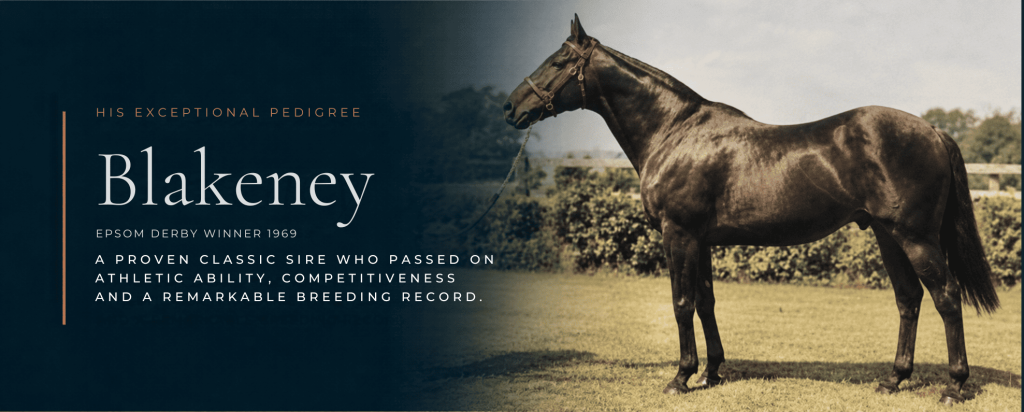
Julio Mariner’s sire, Blakeney, was born in 1966 and secured his place in British racing history when he won the Epsom Derby in 1969. Considered one of the most prestigious races in the Thoroughbred industry, the Derby is contested over approximately 2,400 metres at Epsom Downs and has long served as an important measure of a racehorse’s athletic ability.
Blakeney’s own father, Hethersett, had won the St Leger Stakes in 1962, while his mother, Windmill Girl, was a daughter of Hornbeam. With this combination of established racing bloodlines, Blakeney continued a family tradition of performance in some of Britain’s most demanding Classic races.
Following his retirement from racing, Blakeney embarked on a successful career at stud and produced several notable racehorses. His influence was demonstrated not only through Julio Mariner, but also through other offspring that achieved success in British racing.
For Julio Mariner, this paternal background provided a remarkable foundation. His eventual victory in the St Leger would continue the Classic racing tradition established by his father and grandfather, placing three successive generations of the family among the winners of Britain’s most prestigious races.
While Julio Mariner’s paternal pedigree was distinguished, the achievements of his mother, Set Free, made his immediate family particularly exceptional. Born in 1964, Set Free was a daughter of Worden, a French-bred stallion whose bloodlines had become established within European Thoroughbred breeding. Although her own performances on the racecourse were relatively modest, her subsequent breeding career would prove far more remarkable.
Her daughter Juliette Marny, a full sister to Julio Mariner, won the Epsom Oaks in 1975. Four years later, another full sister, Scintillate, secured victory in the same Classic race. Between these two achievements came Julio Mariner’s own victory in the 1978 St Leger Stakes, making Set Free the mother of three British Classic winners.
Producing a single Classic winner is already a considerable achievement for a Thoroughbred broodmare. To produce three, all from the same mating with Blakeney, made Set Free’s breeding record particularly extraordinary and demonstrated the remarkable results that could emerge from this combination.
Her story also provides an important perspective on the evaluation of breeding mares. Although her individual racing achievements were relatively modest, her ability to produce outstanding offspring established her significance within Thoroughbred breeding. The performances of her descendants offered a much broader indication of her contribution than her own sporting record alone could have provided.
For modern breeders, Set Free remains a fascinating historical example of the importance of maternal families and the value of studying several generations rather than focusing exclusively on the achievements of an individual horse.
Julio Mariner was offered at the Newmarket October Yearling Sales in 1976, where he was purchased for 40,000 guineas by Greek shipping magnate Marcos Lemos. He subsequently entered training with Clive Brittain at his Newmarket stables, beginning a racing career that would eventually take him to some of Britain’s most important racecourses.
His first appearance came in August 1977, and during his two-year-old season he won one of his five races. Although he did not immediately establish himself as the leading horse of his generation, a close second-place finish in the William Hill Futurity suggested that he possessed the ability to compete at a considerably higher level.
His three-year-old season initially proved less convincing. Despite his promising early performances, Julio Mariner struggled to produce consistently strong results against the leading racehorses of his generation. Nevertheless, his connections continued to recognise his potential, and the decision to enter him in the St Leger Stakes would prove to be the defining moment of his sporting career.
On 9 September 1978, Julio Mariner arrived at Doncaster to contest the St Leger Stakes, the oldest of Britain’s five Classic races. First established in 1776, the race is run over approximately 2,900 metres and places considerable demands on the stamina of the competing Thoroughbreds.
Ridden by Edward Hide, Julio Mariner faced a competitive field that included horses with stronger recent form. His performances earlier that season had given little indication that he would emerge as the winner of one of the country’s most prestigious races, making his eventual victory all the more remarkable.
Completing the race in 3 minutes and 4.94 seconds, Julio Mariner secured the most important victory of his career and established his place in British Classic racing history. The achievement was particularly significant given his family background, as it continued the tradition of Classic success established by his sire Blakeney and grandsire Hethersett.
For his trainer, owner and breeding family, the victory represented the culmination of years of careful preparation and selective breeding. For Julio Mariner himself, it ensured that his name would remain associated with one of the defining races in the British Thoroughbred calendar.
HISTORICAL RACE FOOTAGE: Julio Mariner winning the 1978 St Leger Stakes at Doncaster, ridden by Edward Hide.
Following his success at Doncaster, Julio Mariner made one final appearance on the racecourse when he contested the Prix de l’Arc de Triomphe at Longchamp in October 1978. The prestigious international race brought together some of the leading Thoroughbreds of the period, providing a final opportunity for him to compete against elite opposition.
He finished eleventh of eighteen runners behind the winner, Alleged, bringing his racing career to an end with a total of three victories and three second-place finishes from twelve starts.
Although his overall record was not as extensive as that of some of the most celebrated Thoroughbreds of his generation, his St Leger victory had secured his reputation as a Classic winner. At only three years of age, he retired from racing to begin a new career as a breeding stallion, initially within the British Thoroughbred industry.
Few could have anticipated that the most influential chapter of his life would eventually unfold outside the racing world altogether.
After retiring from racing, Julio Mariner began his breeding career in Great Britain, standing at Ashley House Stud near Newmarket from 1979 until 1984. He subsequently moved to Cobhall Court Stud, where he remained from 1985 until 1987. Despite his distinguished pedigree and his success in the St Leger, his early years as a Thoroughbred sire did not produce the level of racing success that might have been expected of a Classic winner.
However, the qualities that had made him an interesting Thoroughbred breeding prospect would eventually attract attention in a different part of the equine industry. During the 1980s, European warmblood breeders were increasingly interested in the introduction of Thoroughbred blood as they continued to develop horses specifically suited to modern equestrian sport.
For many breeders, the objective was to combine the established characteristics of their warmblood families with a different genetic background, while pursuing improvements in athleticism, refinement and suitability for sport. Thoroughbred stallions therefore offered possibilities that extended well beyond their original role within the racing industry.
It was within this context that Julio Mariner’s second breeding career began.
In 1988, Dutch veterinarian and breeder Jan Greve brought Julio Mariner to the Netherlands, where he joined the stallion collection at De Watermolen in Haaksbergen. Greve had developed a reputation for his interest in breeding modern sport horses and recognised the potential value of introducing Thoroughbred blood into established Dutch warmblood families.
Alongside stallions such as Mytens xx, Julio Mariner became part of an approach that sought to broaden the genetic background of the warmblood population while selecting for the qualities required in the international equestrian disciplines.
Rather than assessing him exclusively through the achievements of his racing offspring, Dutch breeders could evaluate his suitability for producing horses with the conformation, athletic ability and temperament required for jumping and other equestrian sports. His Thoroughbred pedigree provided a different genetic background from that of many traditional European warmblood stallions, creating opportunities for carefully considered breeding combinations.
His arrival at De Watermolen marked a significant turning point. Having spent almost a decade within British Thoroughbred breeding, Julio Mariner was now entering a population in which his influence would ultimately become considerably more apparent.
As part of his evaluation for KWPN breeding approval, Julio Mariner underwent a behaviour assessment at Ermelo in February 1988. By this stage, he had already completed his racing career and had considerable experience as a breeding stallion, allowing his temperament and behaviour to be assessed in the context of a mature horse.
The historical assessment described him as particularly friendly, attentive, obedient and honest, with an excellent disposition. He received a score of 9 for character and 8 for stable behaviour, results that complemented his established racing achievements and provided additional information about his suitability for warmblood breeding.
His approval by the KWPN opened the door for Dutch breeders to use a Classic-winning Thoroughbred stallion within their sport horse breeding programmes. He also received recognition from several other European breeding associations, allowing his bloodlines to become incorporated into a wider range of warmblood populations.
What had begun as an uncertain second career gradually developed into the most influential period of his life as a breeding stallion.
Julio Mariner’s contribution to European sport horse breeding became increasingly apparent as his warmblood offspring began to enter competition. Although his own achievements had been established over long distances on the racecourse, his descendants demonstrated their ability in disciplines that required a different combination of athletic qualities.
His influence was particularly evident in showjumping, where several of his offspring achieved international results. However, his importance was not limited to the sporting achievements of his direct descendants. Through his daughters and subsequent generations, his bloodlines became incorporated into a variety of European breeding families, extending his influence far beyond his own lifetime.
Among the successful showjumpers sired by Julio Mariner were Harley, a son out of a Gondelier mare, and Sir Galahad, whose dam was by Farn. Both horses were bred and raised at De Watermolen, where their later sporting achievements contributed to the international reputation of the stud.
Harley competed internationally with Bruce Goodin, while Sir Galahad was associated with Swiss rider Markus Fuchs. Their achievements provided valuable evidence that Julio Mariner could contribute to the production of competitive warmblood sport horses, despite having been bred and selected originally for an entirely different discipline.
Other recorded offspring include Hurricane, Eurocommerce Lima, Jupiter, Resolute, Callisto, Pompadour and Dinky Toy. Together, these horses illustrate the variety of warmblood families with which Julio Mariner was combined and the different directions in which his breeding influence developed.
The significance of his career in the Netherlands therefore lies not in the success of one exceptional descendant, but in the broader contribution he made to multiple breeding combinations and sport horse families.
While the direct offspring of a stallion provide an important indication of his breeding value, his long-term influence may become equally apparent through his daughters and later generations. Julio Mariner offers several interesting examples of how the contribution of a Thoroughbred stallion can continue through the female lines of established warmblood families.
One such example is Simon, an international showjumper who competed with Michael Whitaker. A son of Luidam out of a Julio Mariner daughter, Simon combined the bloodlines of his Thoroughbred maternal grandsire with those of an established warmblood jumping stallion.
Another example is Cinderella Z, a daughter of Chacco-Blue out of Pleasure, by Julio Mariner. Recorded with performances at 1.60-metre level, she represents a later generation in which his bloodlines were combined with those of another influential international jumping sire.
His maternal influence can also be found in Tjungske, a KWPN- and Zangersheide-approved son of Carthago Z. Tjungske’s dam, O.K. Wiggy, was a daughter of Julio Mariner, providing another example of his contribution through the female line.
These descendants demonstrate how his influence continued through subsequent breeding decisions, rather than remaining confined to his own generation. They also illustrate why the contribution of an individual stallion should be evaluated over a longer period, taking into account not only his immediate offspring but also the performance and breeding results of later generations.

The influence of Thoroughbred blood has played a significant role in the development of the modern European sport horse. For generations, breeders have introduced Thoroughbred stallions into established warmblood populations to broaden their genetic diversity and pursue improvements in athleticism, refinement, stamina and overall suitability for equestrian sport.
Perhaps no Thoroughbred illustrates the extraordinary athletic potential of the breed more famously than Secretariat. Born in 1970, the legendary American racehorse captured the Triple Crown in 1973, winning the Kentucky Derby, Preakness Stakes and Belmont Stakes. His performance in the Belmont Stakes was particularly remarkable: he won by an astonishing 31 lengths and established a record of 2 minutes and 24 seconds over 1½ miles, a record that remains unbeaten. His exceptional combination of speed, stamina and athletic ability made him one of the most celebrated racehorses in history.
Secretariat’s significance extended beyond his own racing achievements. Although he did not establish a comparable reputation as a direct sire of champions, his daughters became particularly influential within Thoroughbred breeding. Through mares such as Weekend Surprise, the dam of A.P. Indy, and Terlingua, the dam of Storm Cat, his genetic contribution continued through subsequent generations. His legacy illustrates why the value of a breeding stallion cannot always be measured solely through the performances of his immediate offspring.
While Secretariat became an international symbol of Thoroughbred excellence, stallions such as Julio Mariner demonstrated how Thoroughbred blood could also contribute to the development of European warmblood breeding. Their individual careers followed different paths, but both provide valuable perspectives on the significance of athletic performance, maternal influence and the long-term development of breeding families.
The successful introduction of Thoroughbred blood, however, involves far more than simply increasing the percentage of Thoroughbred ancestry within a pedigree. Not every Thoroughbred contributes the same characteristics, and not every warmblood mare will benefit from the same type of stallion. The conformation, temperament, soundness and athletic qualities of both parents must be carefully considered, alongside the characteristics already established within the maternal family.
Julio Mariner’s achievements as a warmblood sire demonstrate the potential of a carefully considered breeding approach. His influence was established not merely through the presence of his name in a pedigree, but through the sporting achievements of his descendants and the contribution of his bloodlines to subsequent generations of European sport horses.
Although Julio Mariner’s most influential breeding years were spent in the Netherlands, his achievements within British Thoroughbred racing were not forgotten. A statue depicting the stallion was photographed at Ashley Heath Stud in Newmarket, providing a tangible reminder of the horse who had won the 1978 St Leger Stakes before embarking on a second career as a breeding stallion.
The monument represents an interesting connection between two very different chapters of his life. His origins were firmly rooted in the traditions of British Classic racing, where his pedigree, athletic ability and victory at Doncaster had established his reputation. His later contribution to European warmblood breeding would give those same bloodlines an entirely different significance.
For those interested in the history of breeding, the statue serves as a reminder that the influence of an exceptional horse is not always confined to the discipline in which it first achieved success. Julio Mariner’s story began on the British racecourse, but his legacy would continue through generations of sport horses across Europe.
Julio Mariner died on 26 May 2004 at De Watermolen in Haaksbergen, at the age of 29. By then, his life had taken him from one of Britain’s most prestigious racing families to an important position within Dutch sport horse breeding, where his contribution had become firmly established through the achievements of his descendants.
His journey was remarkable not simply because he succeeded in two different breeding environments, but because the second chapter of his career gave an entirely new purpose to the bloodlines that had originally made him a successful racehorse. Through his offspring, his daughters and subsequent generations, his influence extended into breeding families whose descendants would continue to compete in international equestrian sport.
For Maverick Stables, one of these connections holds particular significance. Julio Mariner was the sire of our foundation mare Rosa-Lott, through whom his bloodlines became part of our family’s breeding history long before the Maverick name was introduced.
His story demonstrates that the true legacy of a breeding stallion is rarely defined by a single victory or an individual generation. Instead, it develops through the horses that follow and the breeding decisions that carry his influence into the future.
De Watermolen — The history of Jan Greve and the use of Thoroughbred stallions in sport horse breeding.
De Watermolen — Tjungske — Julio Mariner’s influence through the maternal line.
Julio Mariner — Historical Overview — Pedigree, racing achievements and breeding career.
Alamy — Statue of Julio Mariner — Photograph of his statue at Ashley Heath Stud in Newmarket.