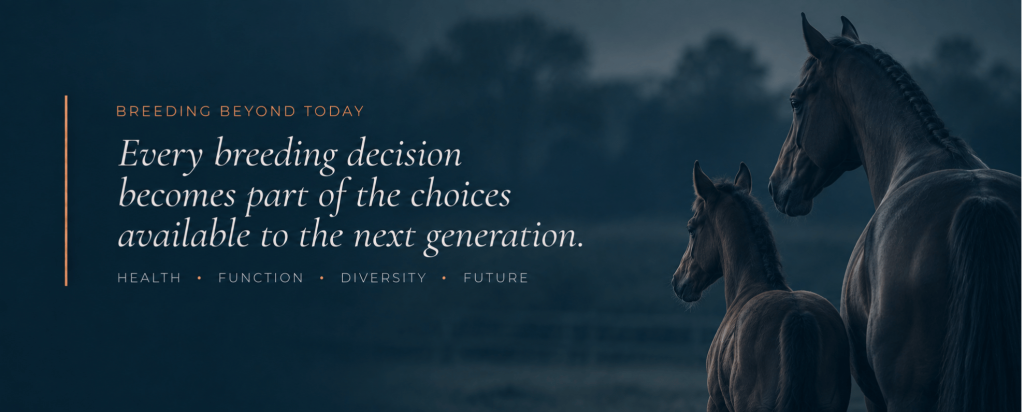
Breeding horses inevitably means making decisions about a future we cannot see. We can study pedigrees, evaluate conformation, compare stallions, look at sport results and examine what previous generations have produced, but there will always be an element of uncertainty. Two full siblings can develop into remarkably different horses, and even a combination that appears ideal on paper offers no guarantee of the horse that will eventually stand in front of us.
For us, that uncertainty is part of what makes breeding so fascinating. It is also why we believe that good breeding begins with gathering as much relevant information as possible. Not because data can remove uncertainty, but because it can help us understand the decision we are making.
At Maverick Stables, the majority of our breeding programme is based within the KWPN. Being a Dutch breeding stable naturally means that the KWPN is close to us, but geography is not the main reason for that choice. What appeals to us much more is the structure behind the studbook and the amount of information that can gradually become available about a horse and its family.
The KWPN breeding goal does not focus exclusively on performance. The studbook aims to breed horses capable of Grand Prix sport while also taking health, functional conformation, movement and character into account. Health is closely connected to durability: athletic talent is only truly valuable when the horse has the constitution to use that talent over time.
That idea is very close to the way we think about breeding ourselves. We are interested in sport, but we do not want to look at sport in isolation. We want to understand the complete horse, the family behind it and, perhaps most importantly, what a breeding decision could mean several generations from now.
That does not mean that we expect the KWPN to tell us what to breed. Quite the opposite. A studbook can collect information, establish a selection system and make generations of results accessible. It cannot stand beside one of our mares in the field and decide which stallion suits her.
That remains the responsibility of the breeder.
Want to learn more about how we approach breeding?
When we talk about our breeding philosophy at Maverick Stables, three ideas return repeatedly: quality, function and longevity. They are closely connected.
We want to breed athletic horses. Depending on the breeding direction, that means looking for the qualities that can eventually allow a horse to perform in jumping or dressage. But athletic ability alone is not enough. The horse also needs a body capable of supporting that ability, a character that allows it to be developed and, as far as breeding can influence it, the foundations for a long and useful life.
This is one of the reasons the broader KWPN selection philosophy appeals to us. Conformation is not assessed simply because a horse should look attractive. The relevance lies in function. The construction of the neck, shoulder, withers, back, croup and limbs influences how a horse can use its body. In the same way, movement tells us more when it is considered in relation to the construction producing that movement.
It is something we also try to communicate through our own Maverick Conformation series. We can separate the horse into individual characteristics in order to study them, but ultimately those characteristics have to work together. A beautiful shoulder does not exist independently of the withers and front leg, just as a powerful hindquarter is only useful when the rest of the body allows that power to travel effectively through the horse.
That way of thinking changes stallion selection as well. We are not searching for the stallion with the most impressive name or the highest-profile sport career and assuming that he will improve every mare. We begin with the mare and ask what she already possesses. Which characteristics would we like to preserve? Where do we see room for improvement? What has her family repeatedly produced, and are those characteristics also visible in her?
Only then does the stallion become part of the discussion.
A pedigree can contain extraordinary names and still leave many questions unanswered. It tells us where a horse comes from, but names alone cannot tell us what those horses were like, how they were assessed, how they performed or what they consistently passed on.
This is where the amount of information collected within a studbook becomes valuable.
When a horse is young, the available information may still be limited. We know its pedigree and we can observe the individual. Inspection results may later add information about conformation and movement or jumping ability. Performance testing can tell us more about aptitude and behaviour under work, while veterinary information adds another perspective. If the horse enters sport, performance results become part of the picture as well.
Years later, something even more interesting begins to happen: the offspring start providing information about the horse as a breeding animal.
This gradual accumulation of knowledge is important because a horse’s own performance and its value as a breeding horse are not necessarily the same thing. A competition result is influenced by genetics, but also by management, training, rider, opportunity and circumstances. Breeding values attempt to answer a different question by estimating what a horse is likely to transmit genetically using information from sources such as pedigree, inspections, ability and performance tests and sport results. KWPN also incorporates genomic information into parts of this system.
We do not regard such a number as an instruction. It is another piece of information that can be placed alongside what we already know.
That distinction matters to us. Breeding becomes dangerous when one result is treated as the whole truth. A high score on one day, an exceptional sport result or an impressive breeding value can all be relevant, but none describes the complete horse.
The real value lies in combining those different sources of information and looking for patterns.

The same principle applies to KWPN predicates. From the outside, it can sometimes look as though predicates form a ladder on which one horse simply ranks higher than another. We find them much more useful when they are viewed as markers of different types of information.
A predicate connected with inspection tells us something different from one earned through sport, and both tell us something different again from a predicate that reflects the achievements of a mare’s offspring. KWPN deliberately distinguishes between these forms of information.
That becomes particularly interesting when studying a mare family over several generations.
Imagine a young mare entering breeding. Initially, we may know her pedigree, her conformation and her movement. Perhaps she completes an EPTM or IBOP, giving us additional information about her natural ability. If she later competes, her own sport record may add another layer.
But her story as a broodmare has barely begun.
Only when her offspring grow up can we begin to see what she actually reproduces. Perhaps several offspring inherit a particular type, movement mechanism or jumping quality. Perhaps they perform successfully in sport. Perhaps daughters themselves become valuable broodmares.
At that point we are no longer evaluating a single horse. We are beginning to understand a family.
That is why we do not simply count predicates when reading a pedigree. We want to know why they are there and what they tell us about the generations behind the mare.
Stallions inevitably receive a disproportionate amount of attention in horse breeding. A successful stallion can cover large numbers of mares, his performances are widely promoted and his offspring may appear everywhere within a population. Yet every foal still receives half of its genetic material from a mare, and every breeding programme ultimately depends on the quality and continuity of its mare families.
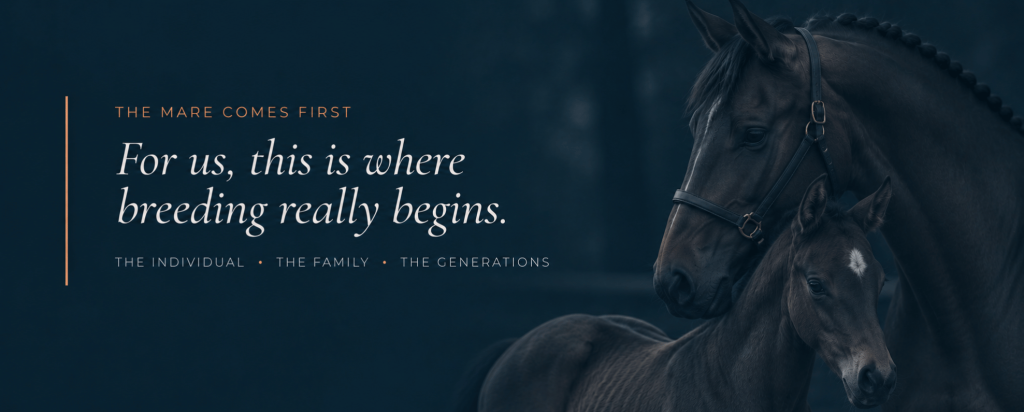
For us, this is where breeding really begins.
We spend considerably more time with our mares than an inspection committee ever can. We may have known them from birth, watched them through different stages of growth and seen them in situations that will never appear during a formal assessment. We know how they behave within a group, how they respond to new situations and how their bodies change as they mature.
That knowledge is extremely valuable, but it also makes an independent assessment interesting.
The KWPN studbook inspection provides another set of eyes. Through linear scoring, individual characteristics are described systematically rather than reducing the horse to a general impression. The system looks at characteristics connected with conformation and, depending on breeding direction and assessment, movement or jumping. KWPN specifically notes that this linear description can be useful when selecting a stallion because it helps breeders identify characteristics that may need to be reinforced or compensated for.
That is exactly how we prefer to use such information.
If an inspection confirms something we have observed ourselves, it strengthens our understanding of the mare. If the assessment differs from our own impression, that is equally interesting because it gives us a reason to look again. The purpose is not to surrender our judgement to a score sheet, but to add an independent perspective.
Performance testing can take that understanding further. An EPTM or IBOP allows qualities to become visible that cannot always be predicted from a horse standing still. We can see how the mare uses her body when a task becomes more demanding, how naturally certain things come to her and how she responds when she is asked to work.
Again, the final score is not the only interesting part. The details behind it can be far more useful when the mare later enters breeding.
And even then, we are not finished, because a mare is never just an individual. She belongs to a family.
When we study a mare for breeding, we therefore look behind her. We want to know what her mother produced, what appears in the granddam and great-granddam, what siblings and half-siblings have achieved and whether certain qualities recur through several generations. KWPN’s documentation of mare families can include precisely these kinds of results, from inspection and performance information to predicates and sport achievements of relatives and offspring.
Sometimes an individual mare may be exceptional within an otherwise less consistent family. In another family, perhaps the individual standing in front of us is less spectacular, but generation after generation has produced useful sport horses.
Those are different situations, and they deserve different consideration.
This is why the dam line carries so much weight in our breeding decisions. A stallion may have enormous influence on an individual foal, but a strong mare family can form the foundation of a breeding programme for decades.
The stallion side of the system gives us a different perspective.
When a young stallion enters selection, there is already a considerable amount that can be evaluated. His pedigree is known, his conformation and natural ability can be assessed, veterinary requirements can be applied and his behaviour and aptitude can be observed during the selection and performance-testing process.
But one important question cannot yet be answered.
What will he produce?
A three-year-old stallion may be exceptional himself, but nobody can know with certainty whether his best qualities will consistently appear in his offspring. That information only emerges with time.
This is one of the aspects of the KWPN system we particularly appreciate. Approval does not freeze the judgement of a stallion at three years old. As his first foals are born and subsequent crops mature, KWPN offspring inspections add further information. Eventually breeders can begin comparing the qualities of those offspring with the mares from which they came. Later still, performance results can add another dimension.
For us, that explains why an older proven stallion can remain extremely interesting even when breeding fashion has moved elsewhere.
With a young stallion, much of the decision is necessarily based on potential. We can study his family, his own qualities and everything the selection process tells us, but his inheritance remains relatively unknown.
With a proven stallion, we can ask much more specific questions. What type of mare appears to suit him? Which characteristics does he reproduce strongly? What do his daughters look like? Do his offspring develop into useful sport horses? Are there weaknesses that repeatedly need to be considered when choosing a mare?
Neither young nor old is automatically better. They simply offer different levels of certainty — and different amounts of time in which their qualities have been allowed to reveal themselves.
That is a distinction we find much more useful than following fashion.
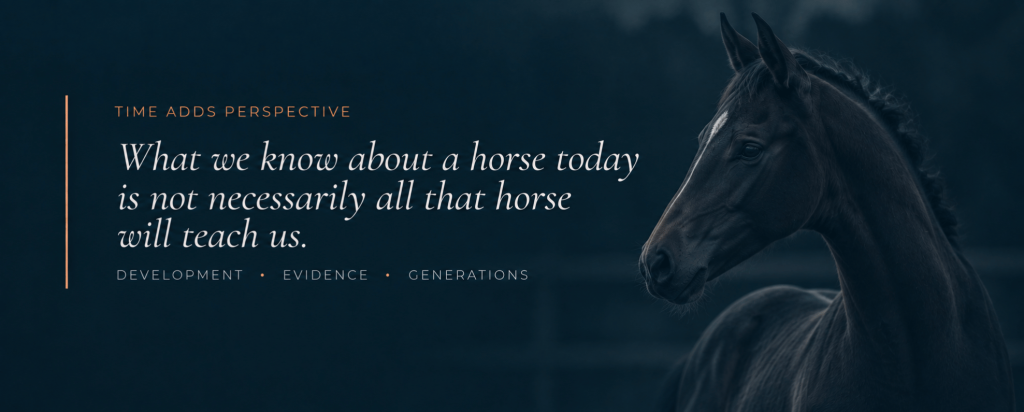
There is another reason we hesitate to judge breeding animals too definitively at a young age: horses do not all develop according to the same timetable.
Some young horses are naturally impressive. They mature early, present themselves well and immediately show qualities that are easy to recognise. Others need considerably more time before their bodies come together or before their athletic ability becomes obvious.
Later performance can therefore change what we know about a horse.
KWPN provides routes through which older stallions can still be assessed, and exceptional performance or breeding results can become relevant later in a stallion’s life.
We find the principle behind that important. Selection should be capable of learning.
It also corresponds with the way we prefer to raise our own young horses. We want to provide a good foundation, but we do not believe that every horse should be pushed towards the same developmental milestone simply because it has reached a particular age.
Some qualities need time before they can speak for themselves.
Thinking in generations also means thinking about where future genetic variation will come from.
Sport-horse breeding naturally concentrates successful blood. When a stallion produces exceptional horses, he becomes popular. If his sons are successful, they enter breeding too. His daughters are retained as broodmares, and before long the same influential ancestors can appear repeatedly throughout a population.
That is not inherently negative. Successful blood becomes successful for a reason.
But it does mean that breeders have to keep looking ahead.
One of the things we value about breeding within the KWPN framework is that useful blood from outside the immediate population can, under defined conditions, be incorporated. This includes horses from recognised populations and, in appropriate circumstances, Thoroughbred influence.
For us, an outcross is not interesting simply because it is different. It has to contribute something.
There may be situations in which Thoroughbred blood can add qualities we consider valuable. Likewise, we are not opposed in principle to looking across the traditional division between jumping and dressage breeding. If a dressage stallion possesses qualities that genuinely complement a jumping-bred mare, we would rather investigate the individual combination than dismiss it solely because of the label attached to each pedigree.
The same applies in reverse.
But there must always be a breeding reason behind it. Being unconventional is not a breeding goal.
The horse remains the starting point.
This long-term perspective is also why we pay attention to both inbreeding and relationship.
The two concepts are sometimes treated as though they mean the same thing, but they answer different questions.
Inbreeding concerns genetic variation within the individual and occurs when related animals appear on both sides of a pedigree. Relationship looks at how genetically common the horse or planned foal is within the wider population. KWPN advises breeders to consider both and provides these figures within its breeding tools.
The distinction becomes especially relevant when we stop thinking only about the foal we are planning now.
Suppose a combination produces a filly that we eventually want to retain. Ten or fifteen years from now, she may become one of our broodmares. The blood we concentrate today then becomes part of the pedigree with which we have to work tomorrow.
Another generation later, someone may be making exactly the same decision with her daughter.
Suddenly, genetic diversity is no longer an abstract discussion about the population as a whole. It becomes a practical breeding consideration.
This does not mean that we automatically reject a combination because an influential ancestor appears more than once. Nor does a particularly low relationship percentage make a mating good in itself. A genetically unusual stallion that does not suit the mare is still the wrong stallion.
Instead, these figures give us another way to test our thinking.
We can ask whether the proposed parents are unnecessarily closely related, but we can also ask a second question: are we producing a pedigree that leaves enough sensible possibilities for the generations that follow?
That second question is increasingly important to us.
Ultimately, this is why the KWPN system fits the way we want to breed at Maverick Stables.
We do not expect it to remove the uncertainty from breeding, because nothing can. We do not expect a predicate to tell us which mare is valuable, a breeding value to select our stallion or an inspection result to replace years of observing our own horses.
What we expect is information.
The more generations that are recorded and assessed, the more context becomes available. A young horse may initially be little more than pedigree, phenotype and potential. Years later, there may be performance information. Later still, there may be offspring. Eventually those offspring may have offspring of their own.
The story keeps developing.
For a breeder, that historical depth is incredibly valuable because breeding itself is a long-term process. Decisions made today may still be visible in pedigrees decades from now.
That is why we want to preserve the strengths of our mare families without blindly repeating the same blood. It is why we remain interested in older proven stallions as well as younger ones. It is why an outcross can sometimes be more valuable to us than the most fashionable combination of the season. And it is why health, conformation and genetic diversity remain part of the discussion even when the primary objective is ultimately to breed a sport horse.
None of those considerations can guarantee that the foal born next spring will be exceptional.
But that is not the standard by which we want to judge a breeding philosophy.
For us, the more meaningful question is whether we can explain why we made the combination, what information we used and what we hoped it would contribute.
Then, when the foal grows up, we observe again.
We compare expectation with reality.
We learn from what worked and from what did not.
And that information becomes part of the next breeding decision.
The mare remains the beginning of the story
After all of this — inspections, predicates, performance tests, health information, breeding values, sport results and pedigree analysis — our decision eventually returns to the horse standing in front of us.
The mare remains the beginning of the story.
We know her in a way that a database cannot. We know how she developed, how she moves when she is not being presented for an inspection, how she behaves within a group and which characteristics have remained consistent as she matured. If she has already produced foals, we can begin comparing those offspring and considering what appears to come from her and what changed with each stallion.
We can then place that knowledge alongside everything the studbook tells us.
That is why even an exceptional stallion can still be the wrong stallion for one of our mares. His sport record may be outstanding and his offspring may be successful, but if the characteristics he tends to reproduce do not complement our mare, none of those achievements makes the mating automatically sensible.
Conversely, a stallion who is less obvious on paper may become extremely interesting when his pedigree, qualities and genetic background answer exactly the questions presented by that mare.
For us, this is the point where breeding stops being an exercise in collecting impressive names and becomes horsemanship.
Why we choose KWPN
So when we say that we choose KWPN, we are not saying that the letters behind a horse’s name determine its quality. Nor do we believe that one breeding system can eliminate the risks and uncertainties inherent in breeding horses.
We choose KWPN because it gives us a structured way to keep learning about the horses we breed from.
It allows us to place our own observations alongside independent assessment. It lets us look beyond a pedigree and investigate what previous generations actually achieved. As mares and stallions grow older, new information can be added through performance, health and offspring. Breeding values and genetic tools allow us to view an individual within the context of the wider population, while an open breeding structure leaves room to consider valuable blood from elsewhere when there is a sound reason to do so.
All of that helps us make a decision, but none of it makes the decision for us.
And we believe that is exactly how it should be.
Our responsibility as breeders is not simply to produce the most impressive foal we can next year. We are also shaping pedigrees that other breeders may work with long after that horse has left our stable. The mare we breed today may have daughters and granddaughters that are still contributing to the population decades from now.
We therefore want to leave them possibilities.
We want to preserve qualities that have proven their value, improve where we believe improvement is possible and remain open enough to change direction when a family tells us something different from what we expected.
That is what makes breeding interesting. It is never finished.
Every generation gives us new information, and every generation asks us to make another decision.
For Maverick Stables, KWPN provides the framework in which we can continue doing exactly that: observing the horse in front of us, learning from the generations behind it and thinking carefully about the generations still to come.
Breed for today. Protect tomorrow.