A pedigree can tell us what might be there. An inspection can tell us what we see. But eventually, a breeder also wants to know what happens when the young horse is asked to work.
Within the KWPN breeding programme, the EPTM and IBOP aptitude tests help answer that question. Both are designed to provide structured information about a horse’s natural aptitude for sport. They do not prove that a young mare is already a finished sport horse, nor can they predict with certainty how far she will eventually progress. What they can do is add another layer of evidence at a point when years of competition results are not yet available.
That makes these tests particularly interesting within a breeding programme. A pedigree tells us what previous generations have produced. A mare inspection gives information about conformation and natural movement. Later sport results tell us what a horse ultimately achieved after years of training, management and development. The EPTM and IBOP sit somewhere between those stages and ask a different question: what qualities does this young horse already possess, and what becomes visible when those qualities are placed within a training environment?
At Maverick Stables, we use both routes. We do not believe every mare should automatically complete an EPTM simply because it lasts longer, and we do not regard an IBOP as a lesser test. The test has to suit the horse.
When the individual mare is ready for it, however, we often prefer EPTM because it gives us something we particularly value as breeders: time to see the horse develop.

Sport ability is difficult to reduce to a single observation.
A young mare can move impressively in freedom yet feel very different under saddle. Another may initially look less spectacular but become increasingly convincing as she understands the work. Rideability, balance, willingness, learning ability and the way a horse uses its body all add information that cannot be read from a pedigree alone.
The KWPN describes both IBOP and EPTM as aptitude tests designed to provide insight into a horse’s natural suitability for sport. The two tests use the same underlying assessment criteria; according to the KWPN, the principal differences are preparation and frequency of assessment.
That distinction is central.
The objective is not simply to identify which horse looks the most spectacular on a particular day. It is to evaluate the ingredients from which sport performance may later develop.
For breeders, this is especially valuable when a mare enters breeding before she has built up an extensive competition record of her own.
The IBOP — Individueel Bruikbaarheid Onderzoek Paarden — is a one-day aptitude test. A mare can participate from 35 months of age and is presented by her own rider or driver. The horse is prepared at home before attending the test.
The EPTM — Eigen Prestatie Toets Merries — is a multi-day mare test. Under the current 2026 KWPN regulations, the regular test lasts approximately 35 days, while the version that includes starting the horse under saddle lasts approximately 49 days. Horses can participate from 35 months of age.
In practical terms, this creates two very different ways of collecting information.
With an IBOP, the horse arrives after preparation within its own training system and the jury evaluates what it sees during that test day.
With EPTM, the horse enters a new environment and is followed throughout a period of training.
Neither format automatically produces better information.
The question is which format produces the most representative information about that individual horse.
At Maverick Stables, our decision begins with the horse rather than the test.
Some mares are naturally adaptable. They travel easily, settle quickly in an unfamiliar stable and remain mentally available even when their entire routine changes. For those horses, an EPTM period can be extremely informative.
Other horses may be more sensitive to a major environmental change. A mare may perform confidently within the training system she knows but need considerably more time to settle somewhere unfamiliar. In that situation, we may deliberately choose an IBOP instead.
That is not lowering the standard.
It is recognising that the purpose of an aptitude test should be to understand the horse — not simply to collect a particular abbreviation behind her name.
This is also why, when we choose EPTM, we generally prefer to send our mares when they are around four years old rather than treating the earliest permitted age as a target.
The KWPN minimum is 35 months. Our preference for approximately four years is a Maverick Stables management choice.
There is a lot for a young horse to process during an EPTM, and we want her to be at a stage where she can genuinely benefit from that experience.
The greatest advantage of EPTM for us is not simply that the test lasts longer.
It is that the horse is seen repeatedly.
During an EPTM, mares come before the jury five times. The first presentation is primarily used to assess whether the horse is testable. The first formal assessment follows later, with subsequent assessment moments during the training period. The interim evaluations are taken into account when the final score is determined. In addition to the regular jury members, the training leader contributes to the assessment, allowing their experience with the horse’s development during daily training to become part of the overall picture.
For us, that is enormously valuable.
A one-day performance gives a snapshot.
Several weeks can give us a sequence.
The jury can see where the mare started, how she responded to the training and what changed as she became stronger and more familiar with the work.
Sometimes qualities emerge that would have been easy to miss on one day.
Young horses can change remarkably quickly once they begin to understand the work.
A mare may arrive somewhat unbalanced and gradually reveal a particularly good canter. Another may initially be tense but become noticeably easier to ride once she understands the routine. A horse that does not immediately make the biggest impression can turn out to learn exceptionally quickly, remain willing and improve consistently from week to week.
The reverse is possible as well.
A mare might make an impressive first impression but find it more difficult to maintain that quality once the work becomes more demanding.
Neither tells the entire story by itself.
What interests us is the development curve.
For breeding purposes, qualities such as learning ability, willingness, adaptability and the way a horse progresses under training can be extremely relevant. They are also qualities that can be difficult to assess fairly during one prepared moment.
This is one of the reasons the EPTM appeals to us.
We are not only interested in what the mare can demonstrate.
We want to know how she develops when something is asked of her.
An EPTM asks more from a young horse than simply learning exercises.
She leaves home.
Suddenly, the stable is different. The horses around her are different. Her handlers, riders, arena and daily rhythm are different. The familiar reference points that make everyday life predictable disappear.
That is a substantial experience for a young mare.
For the right horse, however, we find that this period away from home can contribute noticeably to mental maturity. Horses can return more worldly and more confident simply because they have learned that they can function outside the environment they already know.
This is not unique to the EPTM. It is a principle recognised throughout practical horsemanship. Clinton Anderson, for example, frequently discusses the effect of changing a horse’s environment and the importance of teaching horses to remain attentive and productive away from home. His training material makes the point that horses only become experienced away from home by actually being taken into unfamiliar environments and learning to work there.
We would not turn that practical observation into a scientific claim that every horse automatically “learns faster” away from home. Stress can interfere with learning when a horse is not ready for the situation.
That is precisely why we do not automatically choose EPTM for every horse.
But when a young mare is mentally ready, the experience itself can become part of her education.
The official minimum age and the age we prefer are therefore two different things.
Some three-year-olds are exceptionally mature, both physically and mentally. Others need more time.
Our preference to send many mares to EPTM at approximately four years old is based on everything else that happens around the ridden work.
The horse has to process a new stable, a different routine, unfamiliar people and repeated training while simultaneously being evaluated. We would rather allow a little extra time beforehand if we feel that helps the mare arrive with sufficient strength and confidence to show her qualities fairly.
The objective is not to make the horse as trained as possible before the test.
We still want the EPTM to reveal development.
We simply want the horse to be mature enough for that development to be productive.
For another mare, even at four years old, an IBOP may still be the more suitable route.
Age alone never makes the decision.

The EPTM is not designed to produce a finished sport horse within a few weeks.
Training is progressively built up according to the horse’s level.
KWPN explains that horses are normally trained five days per week, with a rest day during the weekend. In the beginning, work consists mainly of basic walk, trot and canter in both directions. Jumping mares are introduced gradually to poles and small fences after the first period of basic work.
This gradual approach is important because natural aptitude can easily become obscured if the horse is simply drilled towards an examination.
The value lies in seeing how the horse responds to normal progressive training.
Does she understand?
Does she gain confidence?
Does her balance improve?
Does she remain willing?
Does a particular quality become increasingly clear?
Those are the questions behind the score.
For dressage horses, the current 2026 system evaluates walk, trot, canter, suppleness, posture and balance, rideability/workability and overall aptitude as a dressage horse. Walk, trot and canter receive double weighting. A maximum of 100 points can be earned, and 75 points or more is a passing result.
The important part is that this is a broader picture than movement alone.
A spectacular trot does not erase weaknesses in balance or rideability. Equally, a horse does not need to produce the most extravagant movement in the group to be interesting if the complete picture is strong.
Jumping mares are assessed through a comparable philosophy. There, the jury looks not simply at whether the mare clears the obstacle, but at the qualities behind the jump: the canter, reflexes, technique, scope, attitude and rideability.
For us, this is one of the most useful aspects of the aptitude tests.
The horse receives a profile, not just a total.
A score of 80 points immediately attracts attention, but two 80-point mares can be completely different horses.
One dressage mare may gain her strongest marks through canter, posture and balance. Another may distinguish herself through walk, suppleness and rideability.
For breeding, those differences matter.
The total tells us how the entire performance was valued.
The individual marks tell us why.
The same principle applies to jumping. A mare with very fast reflexes and excellent technique but somewhat less scope presents a different breeding question from a powerful mare with enormous scope who could improve in quickness or rideability.
When we analyse a result, we therefore do not start and finish with the total.
We look at how the score was built and then bring the pedigree back into the conversation.
An important part of the KWPN system that is sometimes overlooked is that both IBOP and EPTM can form a route towards the Nationale Merriekeuring — the NMK.
KWPN explicitly states that mares can be selected for the NMK through the aptitude-test route, whether that aptitude test is an IBOP or EPTM. It is important to distinguish this from saying that every mare who passes automatically goes to the NMK. She still has to satisfy the applicable registration, conformation and selection requirements, and the jury must consider her quality sufficient for an NMK invitation.
We can see both routes in practice.
In 2025, Kjento daughter Soof Osterbos was selected for the NMK through EPTM after earning 86.5 points in her test and subsequently 85 points for both conformation and movement. She went on to compete at the NMK that summer.
In 2026, True Love AEH, by Frankie Lee, demonstrated the IBOP route. She scored 85 points in her IBOP, received 80 points for conformation and earned an invitation to the NMK.
That is an important distinction for breeders.
EPTM and IBOP are not dead ends in the selection system. A sufficiently convincing mare can move from the aptitude test into the wider KWPN mare-selection pathway.
Natural sport aptitude and breeding type can therefore come together within the same route.
Because 75 points is sufficient to pass, an 80-plus result already places a mare comfortably above the minimum requirement.
Scores in the 90s are a very different category.
Historical KWPN analysis of jumping aptitude tests showed that only around 0.2% of the analysed horses reached 90 points or higher, illustrating just how unusual such totals are.
Based on the all-time KWPN record overviews and database information I could verify through 2026, these remain the published benchmark scores:
| Test | Highest verified published score | Horse |
|---|---|---|
| IBOP — Dressage | 95 points | Fanita (Vivaldi × Havidoff) |
| EPTM — Dressage | 90.5 points | Enjoy SV (Spielberg × Ferro) |
| IBOP — Jumping | 91.5 points | H-Lucky Retto (Bernini) and Willemijn (Numero Uno) |
| EPTM — Jumping | 93.5 points | La Selien W (Comme Il Faut × Mermus R) |
The dressage IBOP record belongs to Fanita, the Vivaldi daughter and full sister of Desperado N.O.P., who achieved 95 points in 2014. KWPN continues to identify that as the highest IBOP dressage score in its historical coverage.
For dressage EPTM, KWPN’s historical analysis identified Enjoy SV as the absolute EPTM topper with 90.5 points, achieved in 2013. She later became National Champion among the four- to seven-year-old keur and elite mares and progressed to Small Tour level.
The highest published jumping IBOP score is 91.5 points, achieved by both H-Lucky Retto and Willemijn. What makes those results especially interesting in hindsight is that both mares subsequently reached 1.60 m Grand Prix level.
The highest published jumping EPTM score is 93.5 points, achieved by La Selien W. She received 9.5s for several jumping traits, including canter, reflexes, technique and scope. KWPN described the total at the time as a score that had not previously been achieved, and her KWPN database still records the 93.5-point result.
The records are fascinating, but they also illustrate why context matters.
A 95 attracts headlines.
For breeding, we still want to know where those points came from.
For us, EPTM is not only something we know from regulations and databases.
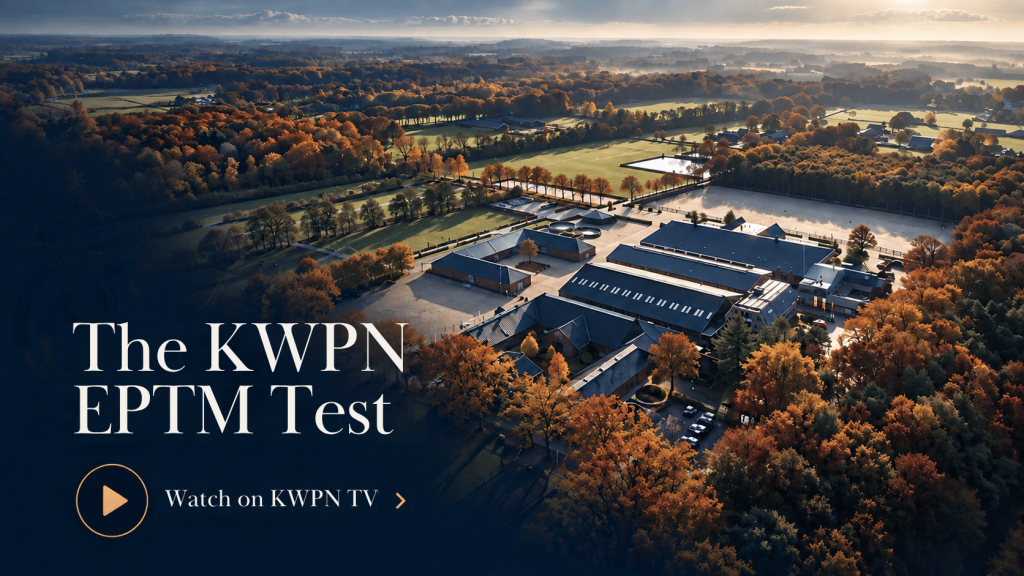
There is a small piece of our own story visible in the KWPN video De KWPN EPTM Test.
Royal Avette was staying in Ermelo for her EPTM during the period in which the footage was recorded. In one scene, the stable board shows her pedigree Lowlands × Daily Diamond. In another, the black mare looking through the stable opening is Royal Avette herself.
For most viewers, she is simply one of the young mares in the stable.
For us, those few seconds show what exists behind an EPTM result.
There are weeks between arrival and the number that eventually appears in the KWPN database: settling into a new stable, getting to know another routine, training, observing, learning and gradually becoming a more experienced young horse.
Royal Avette is out of Laidy Avette and forms part of a female family that is important within our breeding programme. Seeing her within the EPTM environment therefore connects the formal KWPN system with our own breeding story.
The score matters.
But everything that happens before the score is part of the information too.
Our preference for EPTM in many cases should never be interpreted as saying that every mare benefits from several weeks away from home.
Some do not.
A mare may already work exceptionally well with her own rider and perform most naturally within that familiar relationship. A particularly sensitive horse may spend too much of an EPTM period adapting to the change for the longer test to give us more useful information.
In that situation, the IBOP may be exactly the right choice.
The advantage is that almost all preparation takes place within the horse’s normal environment. The mare arrives for the test and can be presented by her own rider, who already understands how she responds.
For some horses, that creates the fairest assessment.
We therefore do not regard EPTM and IBOP as a hierarchy.
The IBOP gives us a snapshot.
The EPTM can give us a sequence.
Once the mare returns home, the EPTM or IBOP result does not simply disappear into a database.
That is when it becomes useful.
We compare the assessment with everything else we know about her.
Did the test confirm what her pedigree suggested?
Did the mare show a characteristic that already occurs throughout the dam line?
Was her strongest trait what we expected, or did something completely different emerge?
Did the EPTM reveal more rideability than we had initially recognised?
Did one particular gait develop significantly during the test?
Was a perceived strength still convincing after several weeks of training?
Those questions give the result context.
If a mare from a family known for willingness and trainability earns particularly strong marks for rideability, that adds another piece of evidence. If a jumping mare combines outstanding technique and reflexes but could benefit from more scope, that can influence our next stallion choice. If a dressage mare has a particularly strong canter but another aspect could be improved, we can incorporate that information when looking at the next generation.
The aptitude test therefore does not choose the stallion for us.
It helps us ask a better breeding question:
Which stallion adds something this female family does not yet possess, without genetically closing the line or limiting the breeding options of future generations?
That is ultimately where EPTM and IBOP become most valuable to us.
Not as trophies.
As information.
| EPTM | IBOP | |
|---|---|---|
| Purpose | Assess natural sport aptitude | Assess natural sport aptitude |
| KWPN assessment principle | Same core criteria | Same core criteria |
| Format | Multi-week training and assessment | One-day test |
| Current regular duration | Approx. 35 days | One day |
| Including starting under saddle | Approx. 49 days | No |
| Minimum age | 35 months | 35 months |
| Who prepares the horse | EPTM training programme | Primarily owner/home trainer |
| Own rider at test | No, horse is trained within programme | Yes |
| Repeated jury observation | Yes | No comparable multi-week observation |
| Development during training visible | Yes | Limited |
| Maximum score | 100 | 100 |
| Passing score | 75 | 75 |
| Possible route to NMK | Yes, subject to selection and other requirements | Yes, subject to selection and other requirements |
| Maverick approach | Often preferred when the individual horse is ready, commonly around four years old | Chosen when the one-day route better suits the individual mare |
The official KWPN summary is simple: IBOP and EPTM use the same assessment principles, while the main differences concern preparation and how frequently the horse is assessed.
When we look at an aptitude-test result at Maverick Stables, the total score is never the entire conversation.
We want to know how the result was built. We want to understand which qualities became stronger during training, which characteristics remained consistent and how the horse responded mentally when the environment and expectations changed.
Then we compare that information with the pedigree and the female family.
That is what turns a test result into breeding information.
A record-breaking score is extraordinary, but even a score in the 90s cannot predict a sport career or guarantee breeding success. Likewise, a mare does not need to approach an all-time record to contribute something valuable to a breeding programme.
Sometimes the most important information is not the biggest number.
It is a quality that keeps returning.